

During my conversations with asset managers and institutional investors over the past year, discussions about AI rarely remain confined to a single aspect. What begins as a conversation about market performance often brings up questions about sustainability, governance and operational risk. Similarly, broader discussions about ESG often move towards AI, its growing impact and the role of human oversight in managing it.
An exploration of AI from a sustainable finance lens today requires looking simultaneously at its investment potential, its environmental and social consequences, and the extent to which human judgment remains essential in interpreting both.
AI Stock Performance in 2026: From Euphoria to Selection
In my conversations with asset managers and institutional investors this year, there has been a gradual but clear change in tone. In 2025, the AI conversation was still dominated by the scale of the equity-market rally: the question mostly, “How do we get exposure?”. By the first half of 2026, that question had become more disciplined: “Which exposure is real, which is already priced, and which risks and opportunities are still hidden?”¹
That shift is visible in the data. In the first half of 2026, the AI trade did not disappear, but it became more selective. Reuters reported that foreign investors sold a net $137.36 billion of Asian equities across key markets in the first six months of 2026, even as South Korea’s KOSPI nearly doubled and Taiwan’s market rose 62%, with the rally concentrated around TSMC, Samsung and SK Hynix. The point was not a simple rejection of AI; it was a rebalancing away from crowded winners and toward cheaper or less obvious parts of the supply chain.
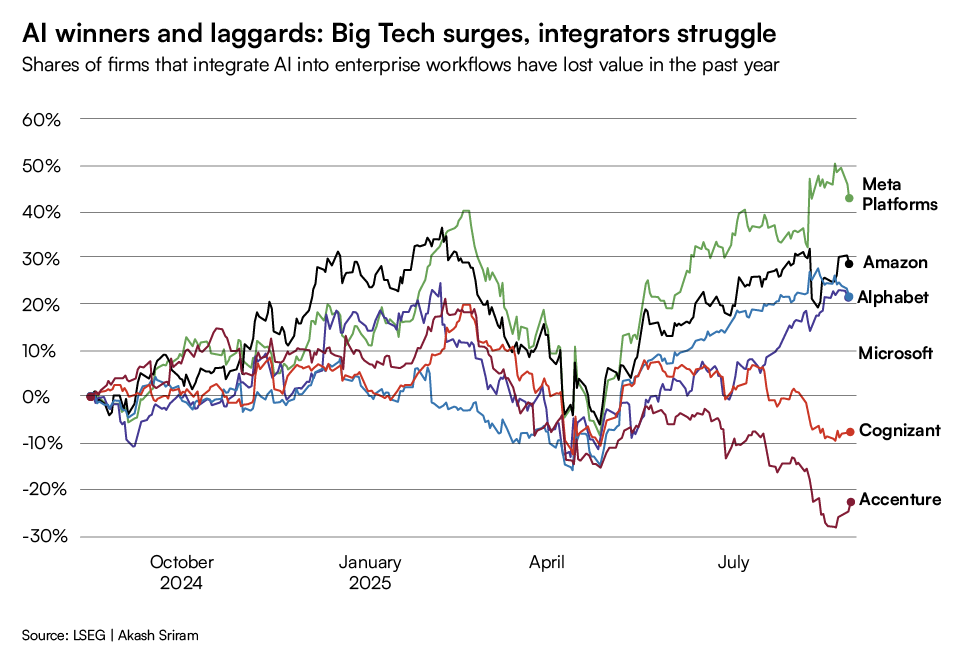
The same pattern can be seen in listed technology names. A Reuters/LSEG graphic showed strong one-year gains for large platforms such as Meta, Amazon, Microsoft and Alphabet, while enterprise-service integrators such as Accenture and Cognizant lagged.² That is not a collapse of the AI thesis; it is a sign that investors are separating infrastructure scarcity, earnings delivery and valuation from the generic AI label.
Read more: AI and ESG: How Governance Plays a Role in Sustainable & Ethical AI
European AI Beneficiaries: Enablers, Not Imitators
For European institutional investors, the more interesting AI opportunity is not necessarily to find a European Nvidia. It is to understand the companies enabling AI: semiconductor equipment, photonics, power systems, networking, cooling, testing, and data-centre infrastructure. Euronews highlighted that several of Europe’s strongest AI-linked performers in 2026 were infrastructure suppliers rather than AI model companies, while also warning that some of the sharpest share-price gains were based on future demand expectations rather than current earnings.³
ASML offers a more fundamentally grounded example. In its Q2 2026 results, the company reported €9.3 billion of net sales and €2.9 billion of net income, raised its 2026 net-sales outlook to €43–45 billion, explicitly linking increased demand for advanced logic and memory chips to ongoing AI-related investment.⁴ This indicates that Europe’s AI exposure may largely be indirect, but it can be economically meaningful when it sits in scarce, strategic parts of the AI stack.
Yet it is important to note that identifying the beneficiaries of AI is only one part of the investment challenge. Investors are increasingly being asked whether the economic gains associated with AI are sustainable considering the environmental, social and governance trade-offs.
Read more: Inrate – AI Report 2026
AI’s Environmental Footprint: The Physical Cost of “Weightless” Intelligence
Another recurring theme in investor conversations is that while AI feels digital, but its physical footprint is an important variable in investment decisions. The IEA projects global electricity generation for data centres rising from 460 TWh in 2024 to more than 1,000 TWh in 2030, with data-centre-related power emissions peaking around 320 Mt CO₂ by 2030 (in its base case).5
Stanford HAI’s 2026 AI Index adds a sharper social and environmental lens: AI data-centre power capacity reached 29.6 GW, Grok 4’s estimated training emissions reached 72,816 tonnes of CO₂e, and annual GPT-4o inference water use may exceed the drinking-water needs of 1.2 million people.6

For ESG investors, this changes the analytical question. It is not enough to ask to what extent AI improves productivity. This question may soon be overshadowed by questions like where the electricity comes from, how water is used, whether local grids can cope, and whether emissions disclosures capture the true lifecycle impact of accelerated compute. AI is an optimisation technology, but it is also an infrastructure demand shock and it is critical to understand how and when these externalities get internalized.
These questions ultimately point to a broader issue: many of AI’s most important risks cannot be assessed through technical performance metrics alone, but require judgment about trade-offs, accountability and acceptable outcomes.
Labour, Governance and Human Oversight
The societal conversation is becoming more nuanced as well. OECD work shows that AI exposure changes the skills demanded in labour markets, with management, business-process, social and originality-related skills increasingly important in high-exposure occupations.7 Stanford’s 2026 AI Index also points to targeted disruption, including pressure on entry-level software roles and customer-service jobs.8
The share of job vacancies related to high AI exposure skills, concerning originality, in both the base year and end year by country

That is why governance matters. Article 14 of the EU AI Act requires high-risk AI systems to be designed so they can be effectively overseen by natural persons, including the ability to understand system limitations, monitor for anomalies, avoid automation bias, interpret outputs, override decisions and stop the system.9 This is not a bureaucratic footnote. It reflects a principle investors should already recognise: where AI affects rights, access, safety or livelihoods, oversight is part of the investment case.
The importance of human oversight is not limited to the deployment of AI systems themselves. It also extends to the way investors evaluate companies, risks and sustainability outcomes in an increasingly AI-assisted research environment.
AI in ESG Data: Scale the Search, Not the Judgment
The same principle applies directly to ESG research and ratings. AI can dramatically improve the harvesting, structuring and analysis of ESG information, but investors still need robust governance and oversight to ensure that environmental, social and human-rights considerations are assessed responsibly and transparently.10 In controversy assessment, for example, I believe human judgment remains particularly important. Within the Inrate methodology for instance, AI-assisted screening and revenue-linked AI exposure analysis plays a part, but assessments also require analyst validation, documented rationale, traceable inputs and quality controls. In controversy research, Inrate monitors more than 4 million sources across 100+ languages and 200+ countries, consolidating events, assessing credibility, impact, scale, durability, involvement and corrective action, and applying analyst review and four-eyes quality assurance. AI can widen the aperture; it cannot become the judge.
The same need for judgment applies to the economics of AI adoption. Beyond environmental and governance considerations, investors must also determine whether the costs of deploying AI at scale are creating durable value.
Token Economics: The Cost of Scaling AI
The final piece is economics. McKinsey estimates that Amazon, Google, Meta and Microsoft are committing more than $700 billion in combined 2026 capital expenditure toward AI infrastructure, and argues that inference costs compound as models are queried billions of times per day.11 TechCrunch reported that companies are already pushing back on AI token costs, citing Uber exhausting its 2026 AI coding budget by April, Microsoft revoking Claude Code licences, and enterprise renewals coming in multiple times higher than expected.12
This reinforces the human-versus-AI economic argument. AI may reduce the marginal cost of some tasks, but unmanaged AI consumption can create a new cost layer of its own. The winning organisations will not simply automate more; they will understand when automation creates value, when it creates risk, and when human review is still the cheaper and more reliable control. In many cases, the human cost that was replaced reappears as a validation layer, resulting in significant shrinkages in AI-drive gains.
Read more: Aggregate Confusion 2.0: Do Chatbots Generate Consistent ESG Ratings?
Conclusion: Optimisation Needs Judgment
My reflection, after many conversations with institutional investors, is that AI is forcing us to evaluate three questions simultaneously.
- The economic question: where is value being created, and which companies are genuinely positioned to benefit from the AI transition?
- The sustainability question: what environmental and social impacts accompany the rapid expansion of AI infrastructure and deployment?
- The operational question: can decision-making requiring judgement be delegated to machines, and do the benefits really outweigh the financial costs, let alone the social and environmental ones?
These questions are often discussed separately, but increasingly they are becoming part of the same investment conversation. Attractive AI exposure needs to consider energy footprint, governance practices and long-term economics along with short-term performance. Companies and investors that are able to simulate the answers to these questions most accurately will be best positioned to integrate AI most effectively.
AI can help us process more information, identify patterns and optimise decisions. But investing has always been about determining what matters most. That remains, at least for now, a fundamentally human responsibility.
Sources:
1. Reuters via Kitco — “Foreigners dump Asia stocks at record pace as AI winners get crowded”
2. Reuters/LSEG — “AI winners and laggards: Big Tech surges, integrators struggle”
3. Euronews — “Beyond Nvidia: Europe’s best-performing AI stocks of 2026”
4. ASML — Q2 2026 Financial Results Press Release
5. International Energy Agency — “Energy Supply for AI”
6. Stanford Human-Centered AI — “Inside the AI Index: 12 Takeaways from the 2026 Report”
7. OECD.AI — “The Future of Work”
8. EU AI Act — Article 14: Human Oversight
9. Lee et al. — “Integrating ESG and AI: A Comprehensive Responsible AI Assessment Framework”
10. McKinsey — “Frontiers of Compute: The Technologies to Reduce AI Inference Costs”
11. TechCrunch — “The Token Bill Comes Due: Inside the Industry Scramble to Manage AI’s Runaway Costs”