


Introduction
AI continues to make headlines across media outlets and attract the close attention of economists, policymakers, and market participants. Recent research from Deloitte shows more than half (53%) of U.S. consumers surveyed are using or experimenting with generative AI. Workplace adoption has also surged, rising from 6% in 2023 to 34%, a more than fivefold jump.i
The technology has also expanded into many sectors, as shown in a recent UBS sector study, and has found multiple use cases within the finance industry.ii In another analysis of financial market trends, Raiffeisen’s experts show that AI tools have become part of the standard playbook for financial companies in developing indicators and decision-making tools.iii
AI Advantages and Disadvantages
Like any technology, AI brings both advantages and disadvantages. Chief among the advantages are productivity gains, which include handling more complex tasks, faster turnaround times, and reduced costs. A report from the Organization for Economic Cooperation and Development (OECD) confirms this idea and provides a detailed analysis of areas where AI has significantly boosted firm and country productivity. iv
Another survey from Pictet Alternative Advisors sustains that about two-thirds of private equity funds expect that AI will decrease their costs and increase their revenue.v
On the flip side, a major concern is the AI impact—particularly on humans and the environment. For workers, AI presents significant challenges across many job sectors and will compel industries to readapt and find new ways of operating. On the environmental side, increasing energy and water consumption are frequently cited as pressing issues.
Other problems stem from the misuse of AI—such as spreading misinformation, generating inaccurate reports or conclusions, data privacy, and presenting unverified data. Survey research from Deloitte confirms that 82% of users surveyed say the technology could be misused.
Read more: ESG Controversies: Identifying Red Flags Across the Value Chain
Bridging AI Risks and ESG Controversies
Interestingly, many of the aforementioned concerns can be captured within an Adverse Business Practices assessment framework, commonly referred to as Environmental Social and Governance (ESG) controversies. It is also worth examining to what extent AI is involved in such controversies and how different these are from those of traditional companies.
Controversies and incidents play a crucial role in the toolkit for ESG evaluations. They provide insights into company behavior that might not be fully disclosed in official corporate reports or sustainability statements. Typically, these controversies represent exceptional occurrences that deviate from normal business operations and are often absent from self-reported data.
ESG Controversies: Background
Controversies, sometimes labelled as Adverse Business Practices, are a core component of Inrate’s ESG Impact Ratings. Rather than relying solely on company-reported data, the methodology integrates multiple dimensions, including product and service assessments and evaluations of corporate social responsibility. By combining these elements with external signals such as controversies, the framework offers a more complete view of ESG performance, capturing both inherent industry risks and potential blind spots in voluntary disclosures.For more insights on controversies, see our research ESG controversies report
Controversy-based scores serve as a critical check on potential greenwashing by introducing external, independently validated insights into ESG assessments. Unlike self-reported data, these third-party findings increase transparency and hold corporate leadership to account. They help surface not only individual incidents of misconduct but also deeper, recurring issues that may signal systemic weaknesses across industries or regions.
Inrate maintains a database containing over 45,000 controversies related to listed companies globally, spanning developed and emerging markets. The controversy research is the basis for the CS Event Score, the CS Indicator Score and the Controversy Involvement Score.
Read more: Navigate ESG Risks with Inrate’s ESG Controversies Scores
A Look at AI-Related ESG Controversies
We work with a global sample in which we identify companies flagged for ESG controversies that relate directly or indirectly to AI activity. The AI component is not necessarily the source of the controversy; it may be an interacting factor or simply part of the broader operational context.
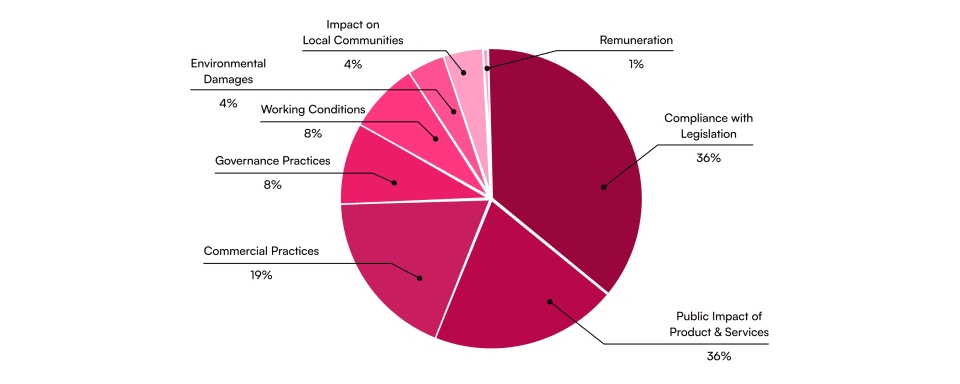
Exhibit 1 breaks down the sample of AI-related controversy events into eight controversy categories. Three categories—Compliance with Legislation, Public Impact of Products and Services, and Commercial Practices—account for 75% of the total incidents recorded between 2022 and 2025.
Compliance with Legislation includes controversies involving tax matters, ethical business conduct, and anti-competitive behaviour. Our sample spans a wide variety of cases, including the misuse of AI technology for alternative purposes such as defence or activities in sensitive countries, manipulation of company reviews, illegal data sharing, violations of antitrust rules, and false advertising.
Public Impact of Products and Services covers all product-related issues, including quality, labelling, health risks, and potential harm to consumers. Notable cases related to AI involve the publication of unverified news through AI systems, the generation of misleading headlines, misinformation, and erratic behavior of chatbots.
Commercial Practices relates to controversies surrounding lobbying efforts, data privacy, content use, and lending practices. High-profile cases in this category include problems with password generation, cyberattacks, unauthorized data collection for AI training, mishandling of client data, and illegal surveillance.
Interestingly, controversies related to working conditions ranked only fourth, with a relative frequency of 8%. These include issues such as forced labor, health and safety violations, and poor employment conditions. Specific AI-related cases point to instances where AI technology was cited as the primary driver of job cuts and outsourcing, the creation of unsustainable work environments, and misuse of AI in hiring processes.
Closely linked to labor-related controversies are those concerning remuneration, although these account for just 1% of total AI-related ESG controversies.
Exhibit 1: AI Controversies across Categories
Source: Inrate, 2022-2025
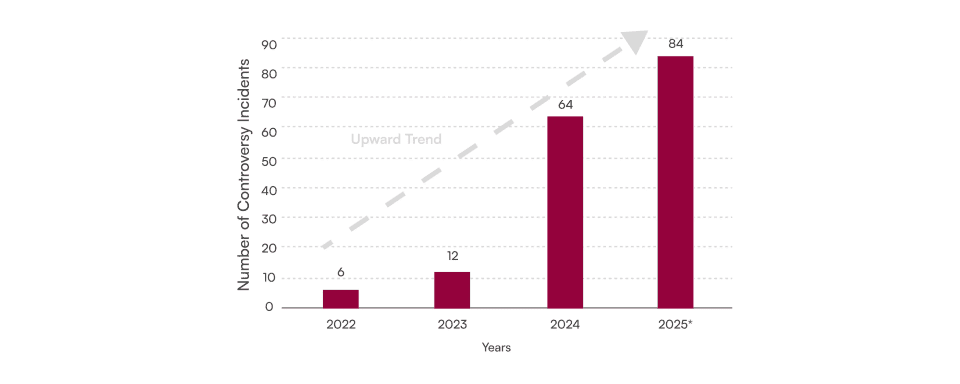
Exhibit 2 reports the number of controversy incidents per year and confirms anecdotal evidence that with the widespread adoption of AI, ESG-related controversies will unavoidably increase in the short-term. For the current year, 2025, we identified 84 incidents directly or indirectly related to the misuse of AI that negatively impacted one or more stakeholders of the company. This number was only 6 in 2022, with AI explicitly mentioned in each incident.
Exhibit 2: AI-Related Incidents across Years: A Sharpe Rise
Source: Inrate, *2025, data year to date.
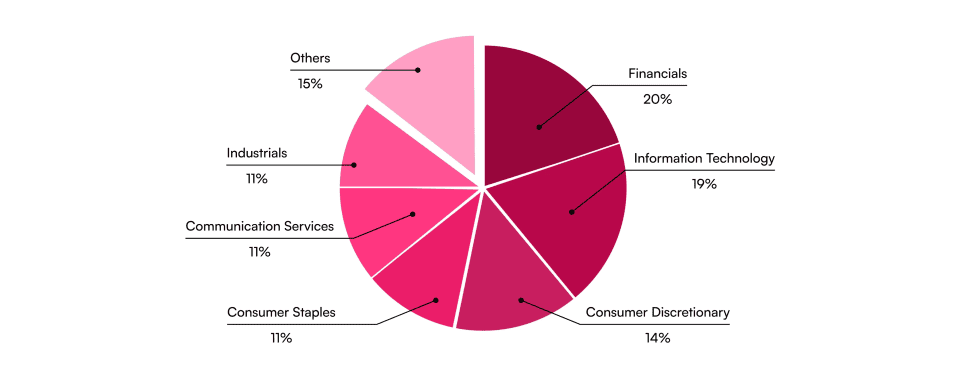
A natural question is whether AI-related incidents are confined to the IT sector. Exhibit 3 reveals a more nuanced picture. The Financials sector leads, accounting for 20% of incidents involving companies in finance. IT follows closely with 19% of total controversy incidents, followed by Consumer Discretionary (14%) and Consumer Staples (11%). Controversies also appear in other sectors such as Consumer Services (11%) and Industrials (10%), though their presence remains modest in the remaining sectors. Worth mentioning, that for a given incident more than one company could be involved.
Exhibit 3: AI Controversies across Sectors: High Stakes for IT
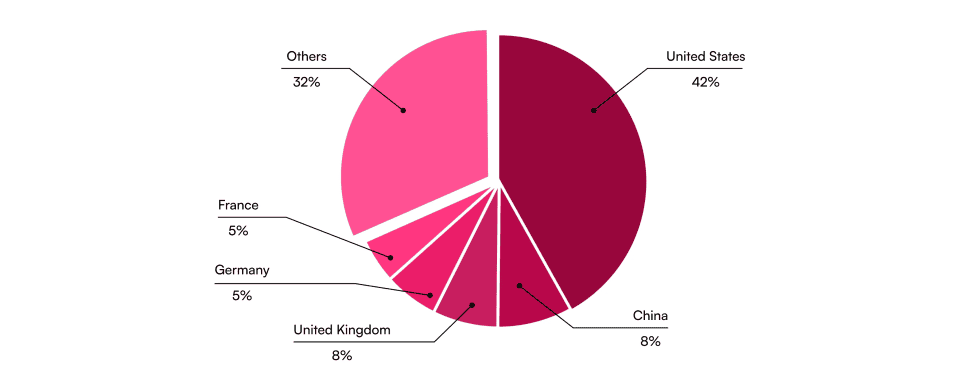
Continuing our analysis of AI-related incidents, Exhibit 4 breaks down our sample of companies by country headquarters and reports the relative frequencies. Unsurprisingly, the U.S. leads the ranking with a relative share of 42%. Other top countries include China (8%), the United Kingdom (8%), Germany (5%), and France (5%). Together, these countries account for 68%, or just over two-thirds, of the ESG incidents globally.
Exhibit 4: AI Controversies across Countries: High Stakes for the US and China
Main Takeaways
AI has triggered massive changes across broad segments of the modern economy in ways we are only beginning to fully understand. While rendering some traditional activities obsolete, it has also created new opportunities and expanded the frontier of what is possible across disciplines, from science to business.
This research highlights the growing challenges that AI may pose for companies and investors. We show that AI not only inherits many of the same ESG controversy patterns seen in traditional sectors but also introduces new concerns—particularly in areas such as data collection, data privacy, misuse of personal information, and working conditions.
Without dismissing the remarkable benefits AI can bring to businesses, this emphasizes the need to proactively address the emerging risks associated with this rapidly evolving technology.
Read more: Navigating ESG Risks with Controversy Scores: A Guide for Investors