

The apparel industry is a textbook case for companies on their long sustainability journey. Few industries communicate their sustainability commitments as vigorously as apparel, yet these commitments are still far from being fully implemented. Most apparel brands continue to operate under a business model driven by purchasing practices that prioritize lower prices and ever-faster lead times, rather than building a truly sustainable industry that safeguards and empowers workers and communities. Understanding the true human rights impact of the apparel industry requires examining available data and company practices.
The need for more impact data
Assessing the apparel industry’s overall human rights record is difficult due to varied reporting standards that often prioritize process over actual impact. Companies tend to report what is convenient rather than what truly reflects their performance. For example, they often highlight the number of third-party social audits conducted, even though these methodologies are frequently flawed, and they rarely provide detailed information on how they remediate the issues identified. Meanwhile, problematic working conditions in subcontracted facilities, which are routinely involved in production, remain almost entirely unreported.
The apparel industry has an impressive track record of trying and failing to advance sustainability. But its journey to actual sustainability is still long. Investors and rating agencies have a role to play to push for better human rights data which enables consumers and investors to hold apparel brands accountable and that is closely tied to companies’ business models.
It is estimated that over 400 million people work in the textile and apparel industry worldwide. The impact of better data would be significant because it would enable investors to set financial incentives for apparel brands to develop sustainable business models.
Read more: Global Standards Screening: Multidimensional Assessment of UNGC Compliance
The promise of living wages
Another key area of concern in this industry is the failure to provide living wages for the workers in the supply chain. The promise of living wages needs to be put into practice. To date, too many workers are trapped in a cycle of poverty as working poor. Paying living wages will increase production cost and prices. But it may also lead to a more loyal and productive workforce, resulting in higher-quality output. For the many female workers involved in the industry, this could be a game changer.
Building long-term relationships
Apparel brands rarely report on how long on average they work with the same production site. While they may talk about strategic partnerships, they do not publish their annual turnover rate of factories, which might be a stronger indicator of a company’s human rights performance than all other sustainability indicators combined. The implementation of a company’s Code of Conduct is only viable when brands commit to long-term partnerships with the same production facilities.
Also, crisis can also reveal how truly an apparel brand is committed to workers’ rights. We saw this during the COVID-19 pandemic, where some companies dropped their “strategic partnerships” while others chose to double down on them. A similar test is expected with the newly imposed US tariffs. Some brands will immediately shift production to lower-tariff countries, while others will carefully consider a more responsible transition. Ultimately, sticking with a trusted business partner, even in the face of higher tariffs, may prove to be the more intelligent long-term business decision. Even with monitoring and long-term partnerships, publicly available information remains too limited to assess true impact.
Read more: Navigate ESG Risks with Inrate’s ESG Controversies Scores

Going beyond the surface
As a result of rather weak publicly available information about apparel companies’ actual human rights performance, it remains difficult for investors and consumers to differentiate between companies that are engaging in greenwashing by pretending to drive change and advance sustainability, and the ones that work on systemic challenges in their global supply chains, such as excessive overtime, harassment and abuse, or forced labor with innovative business models.
The key to rewarding apparel companies based on their actual human rights performance, rather than their performative engagement, is better industry-specific human rights data. To get this data requires a much deeper analysis of the business model of apparel brands. Baumann-Pauly, Massa and Sheriff’s research established that apparel brands with a direct sourcing model and longer-term relationships can work more seriously on improving human rights standards. Without these conditions in place, sustainability commitments are a smokescreen. Investors and rating agencies need to work harder to analyze these key indicators in the industry.
Joining forces
Apparel companies do not need to make these assessments on their own. There are Multistakeholder Initiatives like the Fair Labor Association or the Fair Wear Foundation that can help companies to pool resources and expertise to jointly address challenging non-compliance issues in the apparel supply chain.
Read more: ESG Ratings Regulation 2026: What Investors & Companies Need to Know

Inrate’s Analysis: Focus on the Clothing Industry
An assessment of 236 clothing companies in Inrate’s research universe reveals that 68% have adopted labor policies for their suppliers, covering at least two of the following topics: health and safety, freedom of association, non-discrimination, child labor, forced labor, minimum living wages, maximum working hours, acceptable living conditions, and disciplinary practices. It is encouraging that an equal percentage of companies have implemented monitoring systems to ensure compliance with these policies. However, there are many different types of monitoring systems; while some use external or internal audits, many rely only on self-assessment questionnaires completed by the suppliers.
To improve accountability, apparel companies need to proactively identify and scrutinize high-risk suppliers, for instance, by considering the risk profile of their specific production steps, the composition of their workforce, and their financial capacity to implement labour rights standards. For these suppliers, companies should move beyond self-assessments and conduct more rigorous audits, ideally before starting a commercial relationship with a supplier.
Additionally, transparency is a major concern. Inrate’s analysis shows that only 17% of companies disclose the results of social audits and the actions taken to resolve identified issues. This lack of reporting makes it difficult to assess the industry’s overall progress on human rights. A notable exception are the apparel companies in the Fair Labor Association (FLA). The FLA publishes the corrective action reports based on the findings of independent and unannounced third-party audits.
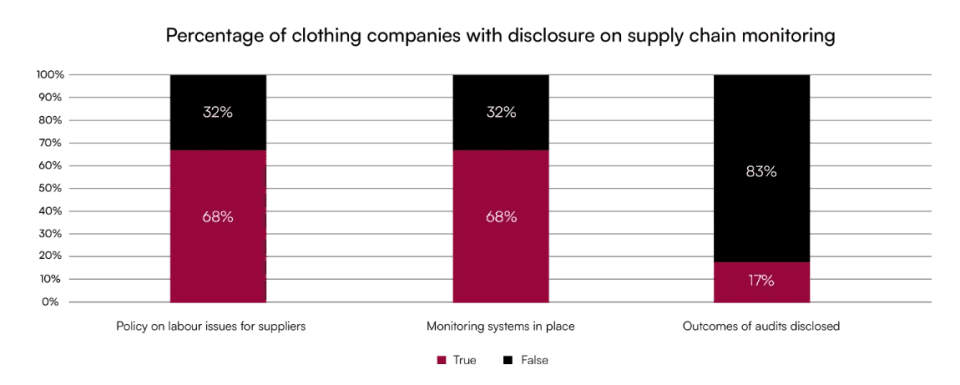
Based on Inrate research on 236 clothing companies, as of September 2025
To differentiate the impacts of clothing companies and go beyond self-reported information, Inrate divides the clothing sector into 6 sub-sectors: accessories and luxury; apparel brands; apparel retail; apparel retail with their own brands; laundry services; and sportwear. Each sub-sector is analysed through an impact matrix to more specifically identify the most negative social impacts of these companies and the topics that are more pressing for them to address. This approach serves to complement the data reported by companies and helps investors shift their focus from the processes in place to assess the actual impacts of the brands on workers and society more broadly.
At the same time, Inrate complements the sustainability assessments of apparel companies through controversy screenings by tracking events reported by reliable third-party sources, including grassroot NGO reports. Inrate collects and assesses information from thousands of sources worldwide and classifies them under different indicators such as child and forced labor; discrimination and sexual abuse; employment conditions; freedom of association; and health and safety. 19% of clothing companies in Inrate’s research universe currently have at least one controversy in 1 of these 5 topics, negatively impacting their workforce (both employees and suppliers), and 7% have controversies in at least 2 of these topics. However, it cannot be assumed that all human rights violations are caught and reported by third-party sources, especially in supplier countries where press freedom is restricted. Therefore, the disclosure of more transparent, meaningful, and audited data by the companies themselves remains of large relevance.
Read more: Inrate ESG Ratings Methodology
Contributors

Prof. Dr. Dorothée Baumann-Pauly
Business Ethics

Marie Froehlicher
Senior ESG Analyst

Nilifer Anaç
ESG Analyst
Sources
- A Holiday Season Wish List for Advancing Business and Human Rights in 2025
- The Rise of Life Cycle Analysis and the Fall of Sustainability - Illustrations from the Apparel and Leather Sector
- Manufacturing in Ethiopia: Decathlon’s Partnership Model
- The Fair Labor Association promotes human rights at work./ Where human rights and business meet.