

Investors are placing increasing emphasis on the credibility of corporate climate transition strategies. Assessing that credibility requires moving beyond operational emissions and evaluating how companies manage emissions across their value chains, where transition risks are often most concentrated.
On average, Scope 3 emissions account for approximately 75% of companies’ total greenhouse gas emissions. This makes Scope 3 emissions a material component of transition risk analysis and an increasingly important factor in evaluating long-term decarbonisation readiness.
At the same time, the gap between climate ambition and implementation remains significant. While value chain emissions disclosure has expanded in recent years, supplier-level emissions reduction remains comparatively underdeveloped. This suggests that many companies continue to face structural barriers such as limited supplier visibility beyond tier 1 suppliers, inconsistent emissions data quality, varying supplier transition capabilities, and constrained influence over complex global supply chains when translating climate commitments into measurable supply chain outcomes.
Operational constraints in Net Zero Strategies
The challenge of Scope 3 decarbonisation is not primarily technological rather operational and coordination-driven in nature. Unlike Scope 1 and Scope 2 emissions, which are linked to assets and activities under direct operational control, Scope 3 emissions are embedded across complex supplier ecosystems. According to the Greenhouse Gas Protocol, Scope 3 accounting spans 15 upstream and downstream categories, reflecting the complexity of emissions generated across procurement, logistics, product use, and end-of-life systems.
Suppliers operate across different jurisdictions, regulatory frameworks, energy systems, and cost structures. Their transition capacity is often shaped by factors outside the direct influence of buyers, including electricity grid carbon intensity, infrastructure availability, and access to capital.
Traditional decarbonisation measures such as energy efficiency improvements and renewable electricity procurement remain important for reducing operational emissions. However, these interventions primarily address Scope 1 and Scope 2 emissions and may have limited impact in sectors where value chain emissions account for the majority of total carbon exposure. However, this creates an important analytical distinction. For instance, a company may demonstrate progress in operational emissions while remaining materially exposed to or even increasing transition risks across its supply chain. For investors, this distinction increasingly matters because operational decarbonisation alone may not provide a complete picture of climate transition readiness as carbon pricing in the supply chain may result in increasing input costs.
From Policy to Implementation: Where Procurement Gaps Persist
Despite growing recognition of Scope 3 materiality, a significant gap remains between emissions disclosure and supplier-level implementation.
Corporate reporting on value chain emissions has improved, supported by expanding disclosure frameworks, investor expectations, and net zero commitments. However, disclosure itself does not reduce emissions. The more complex challenge lies in converting emissions visibility into operational supplier engagement. This implementation gap indicates that procurement-related sustainability commitments are being formalised faster than supplier-level operational practices.

Available evidence in Fig. 1, based on Inrate’s analysis of procurement-related sustainability indicators across its research universe, highlights a clear gap between policy formalisation and supplier-level implementation. The share of companies disclosing green procurement policies increased from 49% in 2023 to 66% in 2024, while the adoption of procurement programs rose from 49% to 62% over the same period.
In contrast, supplier-level implementation remains extremely limited. Fewer than 5% of companies report environmental certifications for contractors, with no meaningful improvement year-on-year. From a sustainability assessment perspective, contractor environmental certifications such as ISO 14001 may provide an indication of the extent to which environmental management practices are embedded within supplier networks through formal governance, monitoring, and continuous improvement processes. The limited adoption of such certifications may therefore suggest that procurement-related sustainability commitments are being formalised faster than they are being operationalised at the supplier level.
This distinction is especially relevant in transition risk analysis, as Scope 3 emissions trajectories alone may not always fully reflect supplier engagement maturity, particularly where emissions trends are also influenced by several factors such business growth, acquisitions, supply chain expansion, or evolving reporting boundaries and methodologies.
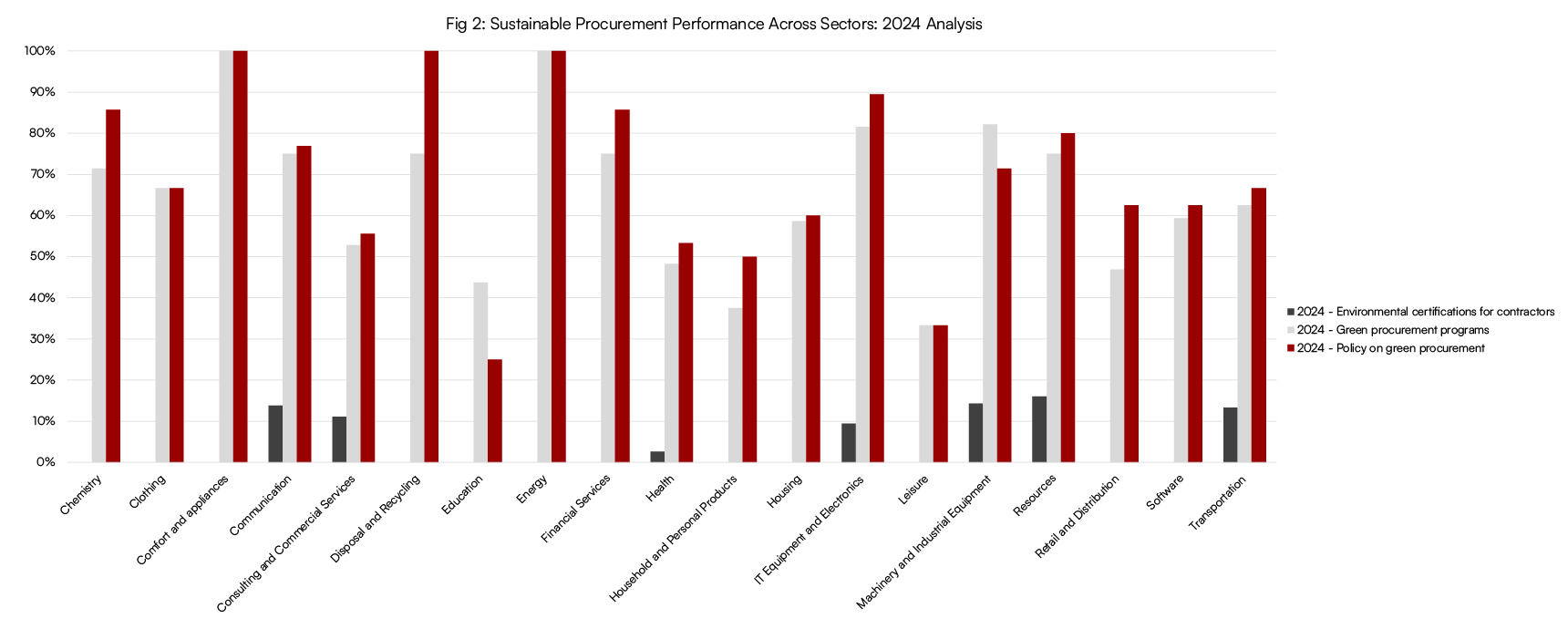
As per Fig.2, it demonstrates sector-level analysis based on Inrate’s data indicating that sustainable procurement maturity remains uneven across industries. Sectors such as Energy, IT Equipment and Electronics, Machinery and Industrial Equipment, and Comfort and Appliances show relatively stronger adoption of green procurement programs and formal procurement policies, suggesting a higher degree of integration of sustainability considerations into supplier governance frameworks. In contrast, environmental certification requirements for contractors remain limited across most sectors, indicating weaker supplier-level implementation. This divergence points to a structural gap between the formalisation of procurement-related sustainability commitments and their operationalisation at the supplier level, with implications for the pace and credibility of Scope 3 decarbonisation pathways.
Data Integrity and the Shift to Evidence
Supply chain complexity also creates material challenges in emissions measurement and reporting. Multi-regional supplier networks operate across different reporting systems, regulatory expectations, and data maturity levels. This limits visibility beyond Tier 1 suppliers and creates challenges in emissions verification.
As a result, many companies continue to rely on estimated emissions models rather than primary supplier data. This may reduce the reliability of transition planning and weaken supplier-level accountability.
At the same time, reporting expectations are becoming more stringent. Frameworks developed by the International Sustainability Standards Board and the European Union are increasing expectations for auditability, comparability, and supplier-level transparency.
Reliable supplier-level emissions data is increasingly becoming a differentiator in transition planning. Companies with stronger supplier data systems may be better positioned to identify emissions hotspots, engage suppliers more effectively, and manage supply chain transition risks with greater precision.
Conclusion
- The decarbonisation of global supply chains is increasingly becoming an operational and strategic challenge rather than a disclosure exercise.
- Scope 3 emissions sit at the centre of this challenge because they represent the largest source of emissions exposure for many sectors and remain among the most difficult to influence.
- The effectiveness of procurement-led decarbonisation may also depend on supplier market structure and buyer leverage within the value chain. Fragmented supplier markets may limit supplier capacity to provide emissions data or implement transition measures, while concentrated supplier markets may reduce buyer influence over supplier-level decarbonisation practices.
- Procurement influences supplier selection, commercial incentives, and transition feasibility across value chains.
- For investors and ESG analysts, procurement maturity may increasingly serve as an indicator of transition credibility.
- Companies with stronger supplier engagement frameworks, more reliable emissions data, and better-integrated procurement strategies may be better positioned to manage supply chain transition risks and improve the credibility of their decarbonisation pathways.
- As value chain emissions continue to dominate corporate carbon footprints, the ability to operationalise procurement as a transition mechanism may become an increasingly important differentiator in evaluating long-term climate resilience.