


Introduction
Over the past few years, the concept of materiality in ESG reporting has undergone significant changes. Companies are now mandated under the Corporate Sustainability Reporting Directive (CSRD) of the European Union to evaluate not only the impact of the sustainability concerns on their own financial performance, but also on the environment and society at large. This two-sided lens of financial materiality versus double materiality is transforming the perception of risk, opportunity, and accountability among financial institutions.
The reporting practices of banks, asset managers, and insurers are changing as they strive to meet the requirements of ESG compliance frameworks. The distinction between the two types of materiality and the manner of their application is no longer a matter of choice. This article decomposes these two concepts, defines them in relation to each other, and investigates the strategic implications of financial institutions operating within the contemporary ESG environment.
What Financial Materiality Really Means
Financial materiality is the expression of sustainability issues that have or might reasonably have a financial effect on a business. This frequently has problems affecting cash flow, cost of capital, financial performance, or access to finance under CSRD and other regulatory regimes.
These are external-in risks, sustainability issues that have bottom-line impacts on the company.
How Financial Institutions Use Financial Materiality
Financial materiality is core to risk management and investment decision-making for banks, insurers, and asset managers. It directly feeds into credit risk models, capital allocation, as well as valuation frameworks. In the case of the Sustainable Finance Disclosure Regulation (SFDR), e.g., financial institutions are to report on the impact of sustainability risks on returns, and that necessitates the determination of the financial materiality of ESG factors.
Financial materiality also enables firms to predict regulatory risk, including being exposed to carbon pricing or shortages of resources.
Read more: Materiality in Private Markets: ESG Beyond Disclosure
What Double Materiality Introduces
The CSRD mandates the concept of double materiality. It is a synthesis of two approaches: (1) the financial effects of sustainability issues on a company (financial materiality), and (2) the effects of a company on people and the environment (impact materiality).
That is, ESG risks can impact a company, and vice versa, and companies must consider the extent to which they are impacted and the extent to which they impact the surrounding world.
How Double Materiality Changes Sustainability Reporting
Under CSRD, a large number of companies are required to conduct a double materiality assessment (DMA) in order to determine which sustainability issues to disclose.
This will demand that they not just consider the financial risk, but also examine environmental harm, societal impacts, and value-chain effects, not only upstream and downstream operations.
In the case of financial institutions, it would mean collecting significantly more data: EU taxonomy data, carbon and pollutant emissions, human rights impacts, and so on. Such disclosures aid in achieving the compliance of ESG and give a more comprehensive view of the sustainability profile of the institution.

Key Differences Explained Simply
Financial Materiality vs Double Materiality — The Core Distinctions
Here is how they differ in several dimensions:
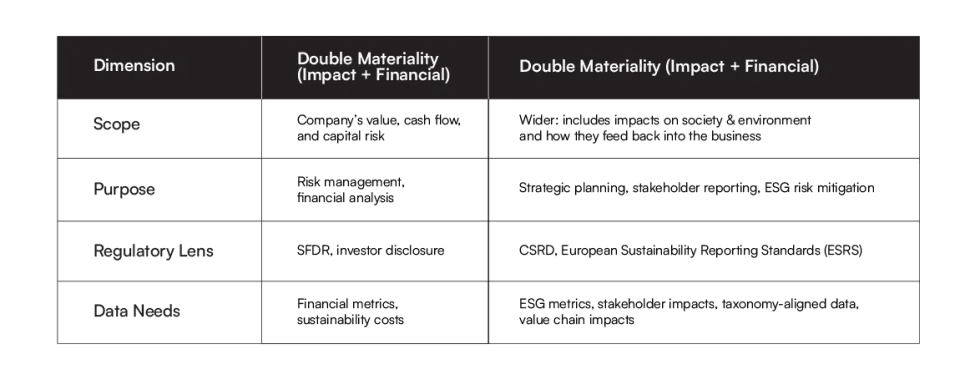
What CSRD Means for Financial Institutions
CSRD Double Materiality for Banks and Investors
The CSRD obliges companies, and in turn some financial institutions, to conduct a materiality test twice and report their findings publicly, in accordance with the European Sustainability Reporting Standards (ESRS).
In the case of financial institutions, this implies they need to report on financial materiality (the implications of ESG issues on their balance sheet) as well as impact materiality (the implications of their business on climate, society, and ecosystems).
Moreover, financial institutions are usually required to reconcile with EU taxonomy information to categorize sustainable operations in their portfolios, and their work on the double materiality becomes more data-heavy and strategic.
The Role of EU Taxonomy Data
The taxonomy data stipulates what economic activities are sustainable according to EU regulations. To companies that are subject to CSRD, complying with the taxonomy is essential, yet difficult, as it involves verified and precise data regarding revenues, expenditures, and environmental impact.
Any financial institution investing in or collaborating with such firms should be cognizant of and control taxonomy alignment risks, which forces them to incorporate impact materiality into their investment and risk management procedures.
Read more: Unlocking EU Taxonomy Data: What Investors Need to Know
Practical Applications of Both Frameworks
When Financial Materiality Works Best
Traditional financial analysis has always been based on financial materiality. In lending, underwriting, or capital-markets investment, institutions use risk models that factor in EWS risks on creditworthiness, profitability, or cash flow.
These tests are directly incorporated into valuation models, stress tests, and scenario planning.
When Double Materiality Is Essential
The concept of double materiality is needed in sustainability-based approaches like impact investing, sustainable lending, or green bond underwriting. It can assist banks and asset managers not only to determine whether a loan is financially safe, but also whether financing is in line with environmental and social objectives.
Active ownership strategies are also backed by double materiality: investors have an opportunity to talk to companies about ESG issues that matter both financially and impact-wise.

Building Better Materiality Assessments
A formal conceptualization of materiality should be taken into consideration by financial institutions:
- Gap analysis: Map current disclosure frameworks and understand where double materiality is value adding.
- Stakeholder involvement: Discuss ESG issues with clients, regulators, communities, and civil society.
- Assessment methodology: Consistent criteria should be used in evaluating financial and material impact. This can be guided using tools and frameworks of consultancies such as PwC or Deloitte.
- Integration: Incorporate materiality findings into strategy, risk management, and reporting cycles.
- Review and revise: Materiality is not fixed — reevaluations are to be conducted in case the business model or the external condition has changed.
Data Challenges and Solutions
Materiality tests are based on sound data. Financial institutions might encounter difficulties in collecting EU taxonomy data and ESG performance data that is verifiable. To address this:
- Apply regular ESG data platforms and vendor tools that are compatible with ESRS.
- Use internal and external assurance to check disclosures of double-materiality.
- Develop or invest with advanced analytics to monitor the environmental and social effects in the value chain.
Future Outlook
Will Double Materiality Become the Global Standard?
Beyond the EU, double materiality is already becoming popular. The concept may gain traction as global investors are increasingly seeking more ESG disclosure and non-EU companies are brought within the scope of CSRD-style reporting.
Impact-oriented metrics can gain increased popularity among the International Sustainability Standards Board (ISSB) and other standard-setters, and the prominent role of ESG materiality frameworks that harmonize financial and societal points of view may increase.

Conclusion
The lesson of financial materiality vs double materiality is no longer an academic exercise, but it is a strategic necessity. To financial institutions, financial materiality and double materiality serve a useful purpose: the lens of financial materiality provides a way to deal with risks and value, and the lens of double materiality gives an understanding of wider societal and regulatory responsibilities.
Through a combination of both strategies, institutions will be able to manoeuvre through the requirements of the Sustainable Finance Disclosure Regulation, comply with EU taxonomy information, and fulfil stakeholder expectations. In a world where ESG responsibility ceases to be a choice, materiality clarity is an impressive weapon—and to stay on top, it is essential to adopt the two sides of the coin with firmness and intent.
FAQs - Financial Materiality vs Double Materiality
1. What is the difference between financial materiality vs double materiality in ESG reporting?
Financial materiality vs double materiality refers to assessing sustainability risks from two angles: financial materiality considers how ESG issues affect a company’s performance, while double materiality also evaluates the company’s impact on society and the environment, as required under CSRD.
2. Why is financial materiality vs double materiality important for financial institutions?
For financial institutions, financial materiality vs double materiality is essential for regulatory compliance, risk management, and responsible investment. It helps banks, insurers, and asset managers meet CSRD and SFDR requirements and strengthens ESG decision-making across portfolios.
3. How does CSRD influence financial materiality vs double materiality assessments?
CSRD mandates companies to apply financial materiality vs double materiality when determining which ESG issues to disclose. Financial institutions must report both how ESG risks affect their balance sheet and how their activities impact people, climate, and ecosystems.
4. What data do financial institutions need for financial materiality vs double materiality?
To conduct financial materiality vs double materiality assessments, institutions need EU taxonomy data, emissions metrics, value-chain impact data, sustainability risk indicators, and stakeholder information. Verified, high-quality ESG data supports accurate reporting and esg compliance.
5. How should financial institutions approach financial materiality vs double materiality in practice?
Institutions should structure their financial materiality vs double materiality assessments through gap analysis, stakeholder input, consistent evaluation criteria, and data assurance. Integrating findings into strategy, risk models, and disclosures ensures compliance and stronger ESG performance.