

What if the question investors have been asking about sustainability was the right starting point but not the right destination?
What is double materiality?
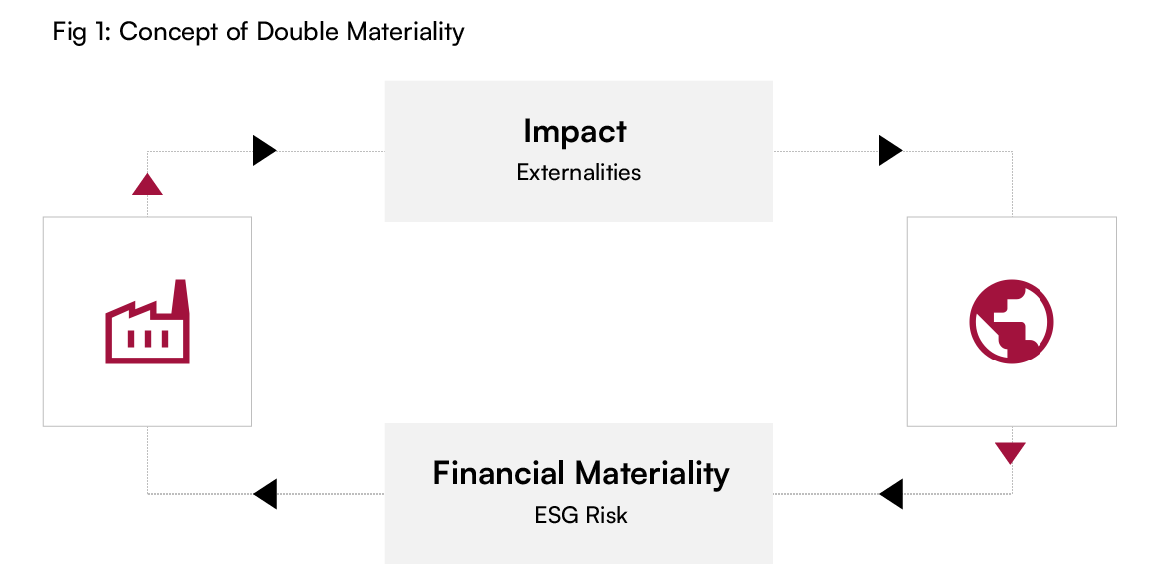
Double materiality means assessing sustainability from two directions at once: how sustainability issues affect a company, and how the company affects people and the environment. Traditional materiality asked only one question: does an issue affect financial performance? Double materiality expands that lens. It includes financial materiality — the outside-in view of how climate change, resource scarcity or social instability affect enterprise value — and impact materiality — the inside-out view of how a company’s activities affect society and the planet, whether those effects immediately show up in earnings.
Financial vs Double Materiality
| Dimension | Financial Materiality | Double Materiality |
|---|---|---|
| Perspective | Focuses on how sustainability issues affect the company’s financial performance | Considers both how sustainability issues affect the company and how the company impacts society and the environment |
| Scope of risks | Primarily current and near-term financial risks | Financial, long-term, and systemic risks, including real‑world environmental and social impacts |
| Materiality lens | Outside‑in (risk to enterprise value) | Outside‑in and inside‑out (enterprise value and impact on people and planet) |
| Regulatory alignment | International Sustainability Standards Board (ISSB) standards (IFRS S1, IFRS S2) | Corporate Sustainability Reporting Directive (CSRD)/European Sustainability Reporting Standards (ESRS) and with alignment to broader impact‑based reporting frameworks |
Regulatory context
Double materiality developed as part of a broader European effort to connect corporate reporting, investor transparency and sustainable finance. At the company level, CSRD and ESRS embed this logic by requiring structured disclosure of material sustainability impacts and risks1,2, while Sustainable Finance Disclosure Regulation (SFDR) applies a similar approach for investors by extending transparency beyond financial materiality to include principal adverse impacts. The EU Taxonomy supports both by providing a common definition of environmentally sustainable activities.
Beyond the European Union, similar themes are emerging through different regulatory routes, including in Switzerland. While implementation varies — and ongoing revisions under the EU Omnibus package show that the framework is still evolving — double materiality clearly signals the overall direction of travel.
Why it matters for investors
Double materiality matters because financial materiality alone often fails to capture risks that build gradually and crystallise over the long term. Environmental damage, weak labour practices or poor business conduct may not immediately affect earnings, but they can compound over time, resulting in financial exposure through regulation, litigation, reputational harm or operational disruption. By considering impacts on people and the environment alongside financial effects, double materiality helps identify long‑horizon risks that are critical to an organisation’s long‑term resilience and value creation.
This is why CSRD1 is significant. It turns double materiality from a conceptual idea into a reporting obligation, giving investors access to structured and comparable information on both business risk and real‑world impact. By contrast, the ISSB focuses on sustainability related risks and opportunities that affect enterprise value — an important perspective, but ultimately a single‑materiality lens. Hence for investors focused on long‑term value and risk, double materiality is not optional: it is the only lens that captures how impacts become financial exposure.
For Inrate AG, the logic behind double materiality is not new. Since 1991, the firm has approached sustainability analysis through a lens that considers both financially relevant risks and companies’ broader effects on society and the environment—long before this way of thinking became widely recognised in the market.
How Inrate makes double materiality actionable
Inrate’s ESG Impact Rating illustrates why double materiality provides a fuller picture than financial materiality alone. Take the example of Mondelez International. Mondelez is a global food company whose core business is snack foods, including biscuits, chocolate and confectionery sold at scale worldwide. As nearly half of its revenue comes from snack food, Inrate begins by assessing the activities’ real‑world impacts — from emissions and resource use to broader environmental and social effects on consumers and society.
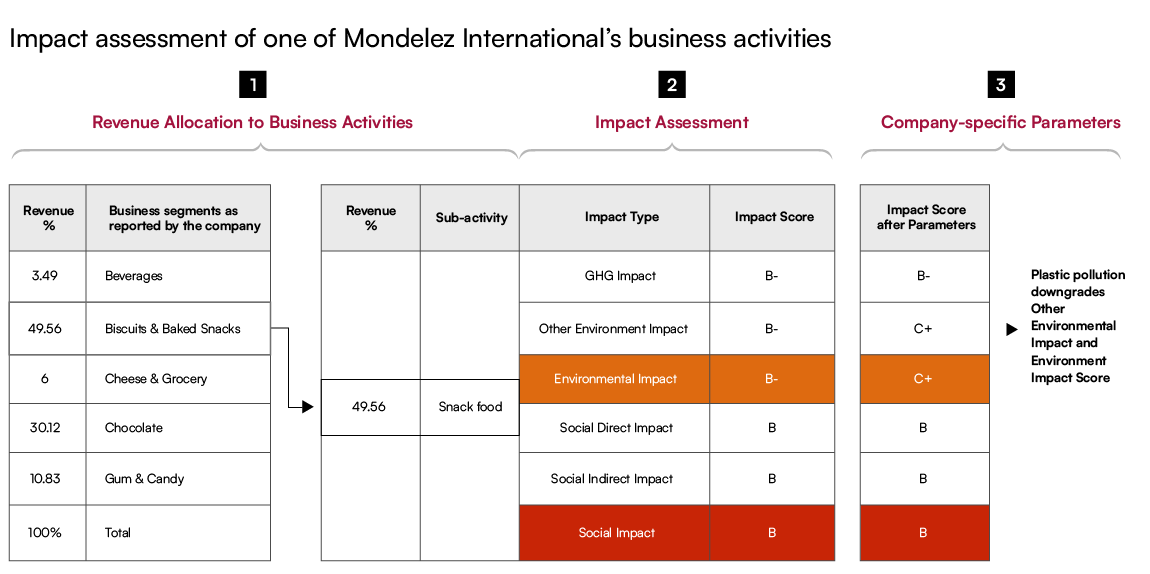
This makes specific issues visible. In the example, plastic pollution lowers the environmental score from B- to C+, while social impact remains at B. Inrate then complements this impact view with an assessment of how well the company manages these issues through its environmental, labour, social and governance practices. A further layer comes from real-time controversy screening, which tests whether actual incidents, corrective action or sanctions tell a different story. Taken together, Inrate’s rating process provides a 360-degree view of double materiality, making it actionable, comparable and grounded in evidence.
This logic underpins Inrate’s broader ESG data solutions — from ESG Impact Ratings and SFDR and EU Taxonomy data to SDG Impact Scores and controversy screening — enabling investors to make more informed investment decisions based on real‑world impacts and company behaviour.
What good double materiality looks like
Credible double materiality starts with a company’s real‑world context. The implementation guidance of European Financial Reporting Advisory Group (EFRAG) 3 indicates that a credible double materiality assessment should be anchored in the company’s strategy, operations and entire value chain, and supported by evidence and documented practical judgment. In practice, this means going beyond formal disclosures and focusing on what a company’s activities do: the impacts they create, the sustainability risks they carry, and how these effects evolve over time.
Why double materiality is hard to get right
The first challenge is complexity. Companies must assess not only financial risks and opportunities, but also real‑world impacts on people and the environment across long value chains and multiple time horizons. The second challenge is judgment. Because the ESRS2 do not prescribe a one‑size‑fits‑all methodology, companies must decide which topics to prioritise, what constitutes sufficient evidence, and how to explain why certain issues are considered material — or not. A third challenge is data quality and comparability. Impact materiality relies on evidence of external effects, while financial materiality requires insight into how sustainability issues translate into business risk or opportunity. Bringing these two lenses together in a decision‑useful way is demanding, which is why double materiality is easier to endorse in principle than to apply effectively in practice. When handled well, this integration gives investors clearer and earlier insight into how impacts become financial risks.
Final reflections
What is now described as double materiality is, in many ways, a recognition that sustainability cannot be understood through a single lens. Companies shape the world around them, and that same world shapes their risks, resilience and long-term prospects. Regulation has begun to formalise that reality, even if the route remains uneven. The real task now is to move beyond compliance and towards assessments that are thoughtful, comparable and grounded in how business works.