


Nature risks are fast becoming systemic risks that touch every part of the economy. Like climate change, the loss of biodiversity and ecosystem services now poses a real threat to financial stability, business continuity, and food security. Central banks, investors, and corporations are starting to catch up, albeit slowly.
What’s emerging from this shift is a concept known as the nature-positive economy, an economic model that rewards long-term, sustainable performance over short-term exploitation. In this model, nature isn’t seen as a resource to extract, but as a foundational asset that underpins everything from agriculture to insurance. Despite the extensive use and exploitation of natural resources often occurring without a price in most cases, the consequences of overuse are severe and range from reduced food security and unhealthy environments to shortages of commodities and natural resources. On the other end, it was shown the natural resources protection and restoration produce significant societal returns and advantages: Waldron (et al., 2020) showed that expanding protected areas to 30% would generate higher overall output (revenues) than non-expansion (an extra $64 billion–$454 billion per year by 2050).
The total annual value of global ecosystem services – the benefits that nature provides to society through ecosystems – is currently estimated at between $125 and $145 trillion, according to the most recent updates from Costanza and colleagues (Costanza et al., 2023). At the foundation of ecosystem services lies biodiversity: biological diversity underpins ecosystem stability and regulation. Biodiversity loss disrupts ecological balance and triggers cascading changes across natural systems. This is why biodiversity is so valuable, not only for the resources it provides, but also for the ecosystem services it sustains and enhances.
For asset managers, this means that protecting nature is key to future-proofing portfolios and aligning with evolving regulatory and market expectations.
Biodiversity as an Unreported Material Financial Risk
For a long time, climate change has been the only environmental impact at the center of environmental disclosure, treated as a standalone urgent environmental matter to be addressed by companies as part of material financial risk. More recently, the alignment of the Taskforce on Nature-related Financial Disclosures with the ISSB, together with increasing knowledge and concern about the challenges posed by biodiversity loss, has led to natural resources and biodiversity being recognized as an integral part of material financial risk.
Nevertheless, many companies are just beginning to understand how nature affects them, and not just the opposite: indeed, nature-related risk reporting is still in its infancy.
This is highly relevant in light of the fact that four value chains – food, energy, infrastructure, and fashion – drive over 90% of all human-made pressure on biodiversity, with the food, beverage, and tobacco industries at the top of the list (Kurth et al., 2021). These value chains are linked to six main sectors – Food & Beverage and Tobacco, Energy, Utilities, Real Estate, Transportation, and Consumer Durables (Apparel) (following named: high-impact sector)- which therefore exert significant pressure on the direct drivers of biodiversity loss: land- and sea-use change, overexploitation of natural resources, climate change, environmental pollution, and the spread of invasive species
Disclosure of Most Significant Drivers of Biodiversity Loss
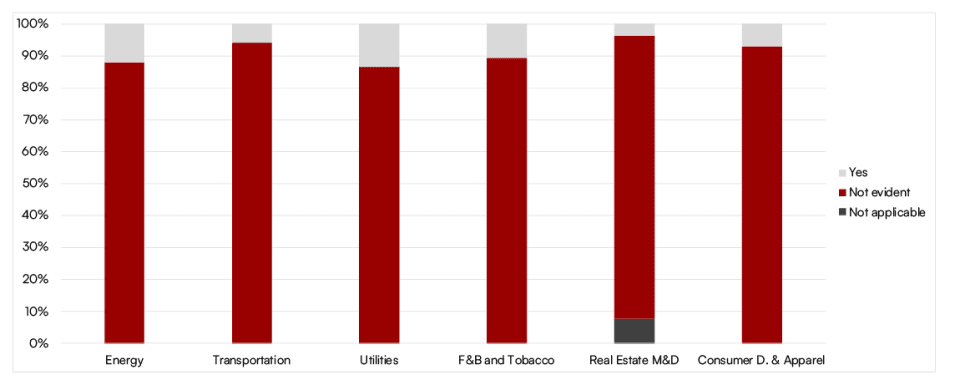
According to Inrate’s data, despite being among the most biodiversity-intensive sectors, disclosure on the main biodiversity drivers remains largely absent across Food, Beverage & Tobacco, Energy, Utilities, Real Estate Management and Development (M&D), Transportation, and Consumer Durables (Apparel). As shown in Fig. 1, the vast majority of companies do not identify neither disclose the main drivers for biodiversity loss related to their operations (where disclosure is indeed, “not evident”), with only a small fraction providing any form of disclosure.
On average, only 9.2% of the companies within these sectors report on biodiversity-drivers. Albeit a small percentage, this is significantly higher than the average across all other industries (3.5%). Yet, this number remains very low in absolute terms, especially considering the breadth of nature-related data expected under emerging frameworks like TNFD and SBTN.
Mitigation Actions
Despite limited internal assessment of biodiversity loss drivers, companies in high-impact sectors are beginning to act. As shown in Fig.2, a growing share of companies in the high impact sectors are implementing actions to avoid or mitigate negative impacts on biodiversity: an early signal of commitment.
Overall, 58% of the companies in the high-impact sectors is engaged into actions to halt or reverse biodiversity loss, against 31% of the companies in the other sectors (Inrate, standard universe).
Sector by sector, Food, Beverage & Tobacco and Utilities show relatively higher adoption of avoidance measures (respectively 42% and 55%), while Real Estate and Transportation include more examples of actions to minimize, in a few cases, restore ecosystems. In the Energy sector, the uptake of avoidance measures is more visible (65%), though it is likely driven by environmental regulations and permitting conditions, rather than a proactive biodiversity strategy.
While restoration remains rare, the data suggests that companies are primarily taking early steps to limit risk and signal a willingness to reduce their impact.
However, progress toward more transformative, nature-positive outcomes remains uncertain, largely due to the lack of specific biodiversity targets.
This interpretation is reinforced by the clear contrast between the number of companies with biodiversity programs in place and the far smaller number that have set measurable targets (as reported in Fig.2: 3.2% in the Energy, 4.9% in Transportation, 11.5% in Utilities sector, 8.5% in Food & Beverage and Tobacco, 4.2% in Real Estate and 7.9% in the Apparel sector). This highlights that, while many initiatives are intended to address biodiversity concerns, they are not yet systematically integrated into structured approaches that start from the identification of key issues at company level that drive biodiversity loss and the alignment of them with defined goals.
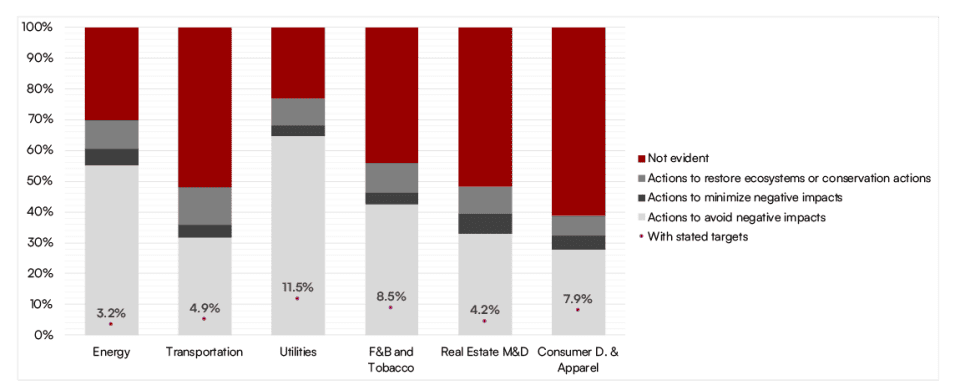
Figure 2 Programs to halt or reverse the loss of biodiversity in high-impact sectors (Inrate, standard universe)
When looking at companies overall environmental performances, the correlation coefficient between the scores of biodiversity-related actions and the environmental score of their Inrate ESG ratings is just 0.24, a relatively low value indicating a weak relationship between biodiversity efforts and companies’ overall environmental performance. This suggests that companies taking action on biodiversity are not necessarily those with the strongest environmental profiles – that in the case of high-impacting sectors is mainly driven by business activities in our ratings – supporting the idea that many of these actions are pushed more by regulatory compliance than by a fully integrated ESG strategy.
Fig.3 reinforces this insight by showing how actions to halt or reverse biodiversity loss are distributed across the full range of environmental grades, with notable activity even in companies rated C, C+, or D+, particularly in sectors like Energy and Transportation. In contrast, the Utilities sector displays a different pattern, with a greater concentration of biodiversity actions among higher-rated companies (B, C+). This suggests that, in Utilities, biodiversity performance may be more closely aligned with overall ESG strategy, possibly reflecting sector-wide shifts in sustainability governance (i.e. increased involvement in renewable energies) and investor pressure. Notably, Utilities sector is the one with the higher rates of companies that have set biodiversity targets (Fig 2).

Figure 3 Relations between E grades and actions to halt biodiversity loss (high-impact sectors). (Inrate standard universe)
While sectors with the highest biodiversity impacts implement mitigation measures, the absence of long-term plans with clearly defined goals
According to this analysis, companies do not yet systematically identify their biodiversity drivers, indicating they are still in the early stages of recognizing and reporting how biodiversity loss could affect their operations, supply chains, and financial resilience.
Despite this, companies in sectors that have high impact on biodiversity have implemented biodiversity-related programs at a higher rate than those in other industries. This suggests that both investor pressure and environmental materiality are prompting some level of response. However, the lack of systematic assessment of biodiversity loss drivers points to limited internal understanding and a fragmented, reactive approach to the challenges posed by nature loss.
The pattern across sectors also reveals that most biodiversity-related efforts are limited to impact avoidance, with far fewer companies pursuing restoration or mitigation. This indicates a generally defensive posture, rather than a forward-looking, nature-positive strategy.
Ultimately, the findings confirm a systemic issue: even where nature-related risk is highest, corporate integration of biodiversity into ESG strategy remains non-systematic and weak.
Contributor

Gloria Luzzani
Methodology ManagerReferences
- Costanza, R., de Groot, R., Sutton, P., van der Ploeg, S., Anderson, S. J., Kubiszewski, I., Farber, S., & Turner, R. K. (2014). Changes in the global value of ecosystem services. Global Environmental Change, 26, 152–158.
- Kurth, T., Wübbels, G., Portafaix, A., Meyer zum Felde, A., & Zielck, S. (2021). The biodiversity crisis is a business crisis. Boston Consulting Group.
- Waldron, A., Adams, V., Allan, J. R., Arnell, A., Palacios Abrantes, J., Asner, G. P., Atkinson, S., Baccini, A., Baillie, J. E. M., Balmford, A., Austin, J., Brander, L., Brondízio, E. S., Bruner, A., Burkart, K., Butchart, S. H. M., Button, R., & Zhang, Y. (2020). Protecting 30 percent of the planet: Costs, benefits and economic implications.