


Stewardship is becoming more sophisticated. But is it becoming more effective?
Investors have never had more tools, more data or more expectations around stewardship.Engagement programs have become more structured. Voting is increasingly integrated with broader ownership strategies. Sustainability data and analytics have become more sophisticated. Regulation and stewardship codes have raised expectations around transparency and accountability.
But there is a question we think deserves more attention: Are we becoming better at stewardship or simply doing more of it?
We think this is an important distinction. More engagement meetings do not necessarily mean more influence. More votes do not necessarily mean better outcomes. And a growing number of reported milestones does not necessarily tell us how much an investor contributed to the change.
Of course, activity matters. It tells us whether investors are using their stewardship capabilities and provides an important degree of transparency. But we believe the next step is to look beyond activity and ask what happens between an investor’s intention and the outcome:
- What was the objective?
- Why was this company or issue prioritized?
- Why was a particular intervention chosen?
- Did the intervention influence the relevant decision-maker?
- What changed?
- What did the investor learn?
This is where we see the next step in the evolution of stewardship: moving from measuring stewardship activity to understanding stewardship effectiveness.
1. A changing stewardship provider landscape
This shift is happening at a time when the stewardship market itself is changing.The market for external stewardship services has grown significantly over the past decade. Investors have increasingly relied on specialist providers for engagement, voting, research, data, reporting and stewardship infrastructure.
At the same time, the boundaries between these services are becoming less clear.
Data is increasingly connected to engagement. Voting is being integrated with ownership strategies. Engagement monitoring is becoming more sophisticated. Technology is connecting research, portfolio information, voting and dialogue in ways that were previously much more difficult.
Recent changes in the provider landscape point to a broader reconfiguration of the market. The withdrawal or repositioning of individual providers should not simply be interpreted as evidence that demand for stewardship is disappearing. Rather, it raises questions about where specialized stewardship capabilities create value and how those capabilities should be delivered.
For investors, this creates a broader strategic question: If an external provider changes its business model, exits a service or restructures its offering, should the response simply be to find another provider?
In some cases, of course, that may be the right answer. But these moments can also provide an opportunity to step back and ask: Is our stewardship model still designed to achieve what we want it to achieve?
That is not only a question about providers. It is a question about the overall operating model.
- Which capabilities should sit in-house?
- Where does external expertise add genuine value?
- Which decisions need to remain under the investor’s strategic control?
- How is institutional knowledge preserved when stewardship activities are outsourced?
Stewardship is inherently long term, while providers, technologies and business models can change. A resilient stewardship model therefore needs to preserve strategic ownership and institutional knowledge while making effective use of external capabilities where they add value.
And one principle remains important: Outsourcing execution does not mean outsourcing responsibility. The investor remains responsible for the objectives, priorities and outcomes of its stewardship activities.This makes the question of effectiveness even more important.
Scope: starting with listed equity stewardship
This article focuses primarily on stewardship in listed equities, where investors typically have established mechanisms for dialogue, escalation and the exercise of shareholder rights. This provides a useful starting point for examining stewardship effectiveness: what are investors seeking to achieve, how do they assess progress, and when can an outcome reasonably be linked to their stewardship activities?
At the same time, the question of effectiveness extends beyond listed equities. Fixed income and alternative asset classes offer different forms of investor influence and therefore may require different approaches to assessing stewardship outcomes. We return to this broader question towards the end of the article.
2. The stewardship influence toolkit
Investors have a broad and increasingly sophisticated stewardship toolkit. The challenge is not necessarily to use more tools. It is to understand which tools or combination of tools are most appropriate for a particular objective.
1) Build knowledge and the case
Research can identify risks, opportunities, corporate weaknesses and potential solutions. It provides the evidence needed to understand the problem and build a credible case for change. Good stewardship therefore starts before the first engagement meeting. It starts with understanding the issue, the company and the relevant decision-making context.
Good stewardship starts with knowing what you are trying to change and why.
2) Shape the wider environment
Not every problem can be solved by engaging with one company. Public policy and system-level engagement can address issues where the underlying drivers are structural for example, regulation, market standards or industry practices.
This can be particularly relevant for systemic issues where outcomes depend on the behavior of multiple market participants.
3) Influence corporate decision-making
This is where most investors probably spend the greatest part of their stewardship resources:
- Direct engagement allows investors to communicate expectations, exchange information and negotiate change.
- Collaborative engagement can increase investor leverage where an individual investor would otherwise struggle to have sufficient influence.
- Voting provides a formal mechanism for expressing support or opposition and holding boards accountable.
- And shareholder resolutions can put specific proposals or expectations directly before shareholders.
Importantly, these mechanisms do not have to be used in isolation. The most effective approach may be a combination of several tools, depending on the objective and the circumstances.
4) Use financial leverage
Stewardship does not end with dialogue. Capital allocation can reinforce stewardship objectives by integrating corporate progress into investment decisions.
- Divestment may be appropriate where other approaches have failed, where risks are incompatible with the mandate, or where continued ownership no longer provides a credible pathway to influence.
- Litigation, where appropriate, can provide another mechanism through which investors protect their rights or seek accountability.
We therefore do not see stewardship as a fixed escalation ladder, where investors simply move from one tool to the next.
The better question is: Which mechanism – or combination of mechanisms – gives us the best chance of achieving the objective?
That may mean a private conversation. It may mean collaboration. It may mean voting against management. It may mean changing capital allocation. And sometimes it may mean combining several of these approaches.
The point is not to use the strongest tool. The point is to use the right tool.
3. From influence to effectiveness
This brings us to the heart of the question: how do we know whether stewardship is effective? We think it helps to look at stewardship as a continuous loop.
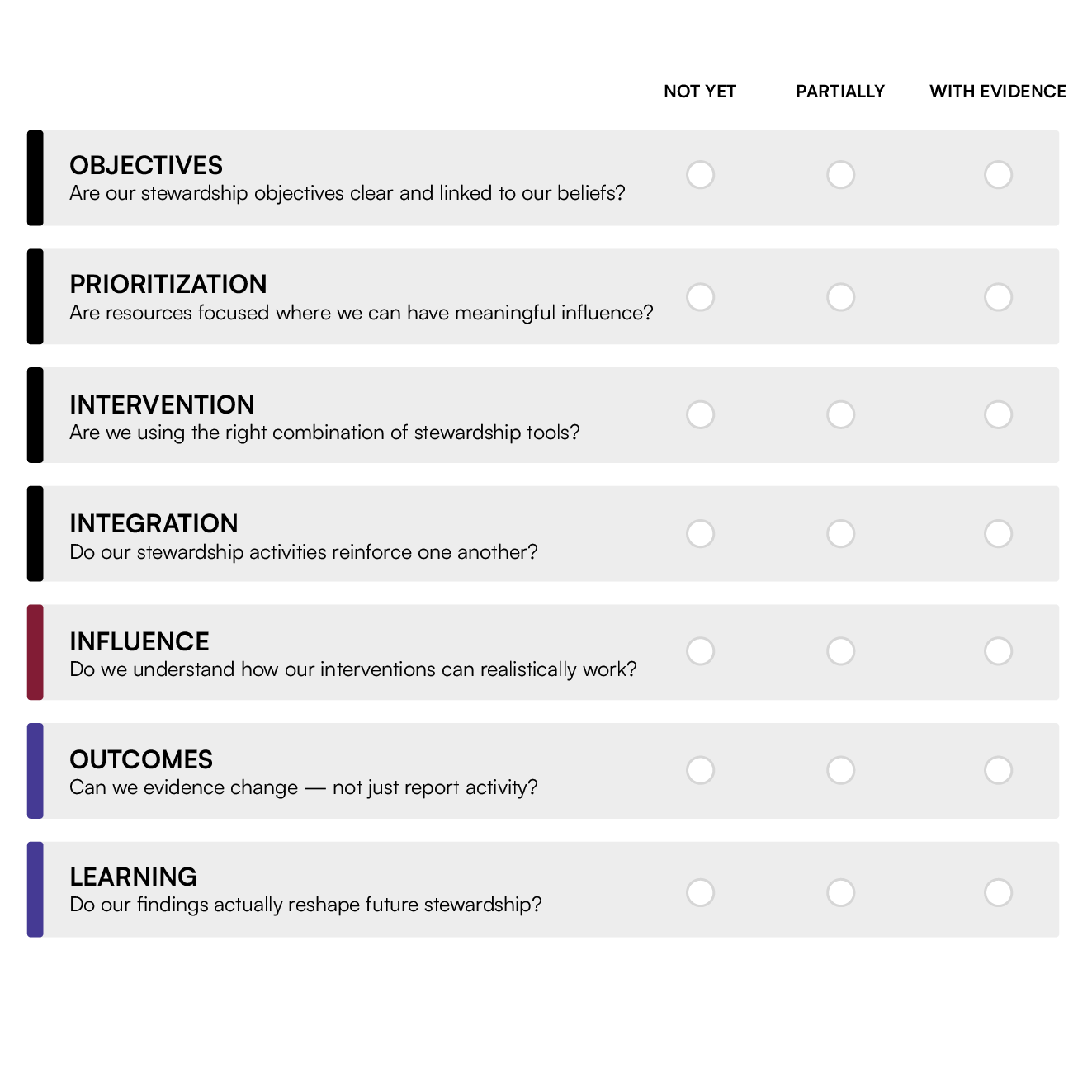
The logic is straightforward: First, define your objectives and what you are trying to achieve. Then identify where you have a realistic opportunity to influence change and prioritize. Choose the intervention that best fits the situation. Assess your credible pathway to influencing the relevant decision-maker. Look at the outcomes and what actually changes. And finally, feed that experience back into future decisions and learn.
Each step matters.
1) Objective
What are we trying to achieve? A clear objective provides the foundation for everything that follows. It should be specific enough to guide action and realistic enough to allow progress to be assessed.
2) Prioritization
Where can the investor make a meaningful contribution? Not every material issue, company or risk can receive the same level of attention. Prioritization therefore needs to consider both the importance of the issue and the investor’s ability to influence it.
3) Intervention
What is the most appropriate way to act?
The answer might be direct engagement, collaborative engagement, voting, shareholder resolution, policy engagement, capital allocation or a combination of approaches.
4) Influence
Did the investor actually influence the relevant decision-maker?
This is an important but often underdeveloped part of stewardship evaluation. Influence does not necessarily mean that a company immediately adopts every investor request. It may mean that the investor changed the quality of the discussion, contributed to a decision, altered the company’s understanding of investor expectations or helped build momentum for change.
5) Outcome
What changed?
This is where stewardship reporting often places the greatest emphasis. Milestones, commitments, policy changes, targets or implementation can all provide evidence of progress.
But outcomes need to be interpreted carefully. Corporate change can have many causes. Regulation, market developments, management decisions, other investors and wider stakeholder pressure can all contribute.
For this reason, direct causality can be difficult to establish. That does not mean influence cannot be assessed.
It means we need to think in terms of contribution, rather than assuming that every corporate change was caused by a single investor intervention.
6) Learning
And finally: What did we learn? This is perhaps the most overlooked part of the process. Perhaps the engagement strategy worked particularly well. Perhaps the investor overestimated its leverage. Perhaps collaboration made the difference. Perhaps the issue turned out to be less material than initially thought.
A stewardship outcome should not simply close a case. It should provide information that improves future decision-making.
This turns stewardship into a learning process rather than a series of isolated activities.

These lessons matter because stewardship is rarely a simple cause-and-effect exercise.
Corporate change can result from several investors acting together, changing regulation, market developments, management decisions or broader stakeholder pressure. It is therefore often difficult to claim direct causality. But that does not mean influence cannot be assessed. There is an important difference between asking “Did we cause this change?” and asking “What was our contribution to the change?”
An engagement meeting is an activity. A company commitment may be a milestone. A change in corporate behavior may be an outcome. Understanding the investor’s contribution to that change is a further step.
The more sophisticated stewardship becomes, the more important these distinctions will be.
4. From portfolio data to stewardship priorities
If effectiveness is the goal, prioritization becomes critical. Investors have never had access to more information about their portfolios: exposure, ownership, ESG risks, controversies, double materiality, corporate performance and much more.
The challenge is no longer simply finding information. It is deciding what to do with it. A company may have a significant sustainability risk, but limited investor leverage. Another company may have a less obvious risk but a highly material issue, significant ownership and a management team that is receptive to change.
This is where we see the value of combining different types of intelligence:
Exposure x Materiality x Leverage = Prioritization
Here, the three dimensions are deliberately broad.
- Exposure asks: how significant is the investor’s financial or portfolio exposure?
- Materiality asks: how important is the issue from a financial, sustainability or systemic perspective?
- Leverage asks: what realistic ability does the investor have to influence the company or relevant decision-maker?
This is not intended as a mathematical formula or a mechanical scoring model.
Rather, it illustrates a principle:
Effective stewardship requires prioritization based not only on where risks are highest, but also on where investor influence is meaningful and where action has a credible pathway to change.

This is where sustainability data and analytics can add significant value. Better data can help investors identify relevant exposures, understand material issues, compare companies and identify potential areas for action.
But data should inform stewardship strategy and not replace it. Prioritization is therefore not simply about finding the “worst” companies. It is about identifying where the combination of importance and influence creates a meaningful opportunity for stewardship. But prioritization is only the starting point. Once a company or issue has been identified as a stewardship priority, investors still need to determine what kind of intervention is most appropriate. The relevant question is not simply how material an issue is.
It is also how the investor can realistically influence the outcome. The nature of the issue, investor leverage, company responsiveness and the available stewardship mechanisms all matter.
This is why stewardship cannot become a purely automated decision process. Data can help identify priorities and inform the choice of intervention. But stewardship still requires judgement. The same issue may call for direct engagement in one company, collaboration or voting in another, and a broader system-level response elsewhere.
Good stewardship is therefore not simply about having better data. It is about using better intelligence to make better decisions.

5. What data and technology can and cannot do
Technology is changing stewardship quickly. Advanced analytics and AI can help investors identify emerging controversies, assess materiality, compare companies, monitor engagement progress and manage increasingly large amounts of information.
Technology can also help bring previously separate activities together: research, voting, engagement and reporting. But there is a limit to what technology can do.
- It can tell us that a company has a particular risk, but it cannot decide whether engagement is the right response.
- It can identify a potential priority, but it cannot determine whether an investor has sufficient leverage to influence the outcome.
- It can track a milestone, but it cannot, on its own, tell us whether that milestone represents meaningful change.
Those remain questions of judgement. The opportunity, therefore, is not simply to automate stewardship. It is to connect intelligence, decision-making, action and learning.
In other words, to turn data into stewardship intelligence. The value of technology is not only in generating more information. It is in helping investors make better decisions about where to focus, how to act and what to learn from the results.
6. A European stewardship landscape in transition
There is another reason why this discussion is timely: the European stewardship landscape itself is evolving. SRD II and national stewardship codes have helped establish stronger expectations around shareholder engagement, voting and transparency. But approaches remain different across European markets. The result is a stewardship landscape that is increasingly sophisticated but also fragmented.
The question now is not simply whether we need more stewardship frameworks. It is whether existing frameworks can help investors become more coherent, more comparable and ultimately more effective in their stewardship.
That means thinking beyond reporting requirements and towards the quality of the stewardship process itself: how investors set objectives, prioritize, intervene, assess outcomes and learn.
7. A simple stewardship health check
So, where does this leave investors? We suggest starting with a few relatively simple questions:
- Are our stewardship objectives clearly linked to our investment and sustainability objectives?
- Are we prioritizing the companies and issues where we have both materiality and leverage?
- Are we using the full range of stewardship tools available to us?
- Are voting, engagement and escalation decisions sufficiently integrated?
- Can we distinguish activity from genuine progress and outcomes?
- Do we understand where external providers add value and how we assess their performance?
- Do we systematically learn from stewardship outcomes and adapt our approach?
These questions do not require a completely new stewardship model. They provide a way to examine whether the existing model is working as intended.
8. Conclusion: The Next Frontier
We do not think the answer is to abandon activity metrics or to suggest that engagement, voting or reporting no longer matter. They do. The point is that activity is a means, not the end.
The stewardship market has already moved beyond the question of whether investors are active owners. The next challenge is to understand:
Are our stewardship activities helping us achieve our objectives and are we getting better at doing so over time?
That requires a stronger connection between the different parts of the stewardship process (see graph Stewardship Effectiveness Chain).
For investors, this means thinking not only about how much stewardship they conduct, but about how deliberately it is designed.
For providers, it means demonstrating value beyond activity volumes. and for the stewardship ecosystem as a whole, it means developing better ways to understand influence, contribution and outcomes.
The objective is not simply to do more stewardship. It is to make stewardship more effective. And perhaps that is the next stage in the evolution of active ownership: moving from a focus on activity to a focus on effectiveness.