
Introduction
The enthusiasm surrounding AI has recently been tainted by doubt and anxiety among investors and the broader public. At the heart of this is growing uncertainty about the impact of AI technology on security and society.
On the one hand, proponents of the technology highlight that AI has boosted productivity, enhanced product quality, and shortened development cycles. AI should therefore be promoted, further steering the economy up and bringing additional wealth to society.
Without denying these remarkable benefits, challenging views highlight growing concerns stemming from environmental issues such as increased energy and water consumption. In addition, the scope of risks has increased over time to include cybersecurity, data privacy, human rights, and broader societal issues related to governance and the labor market. The speed at which AI technology and capabilities have advanced has led some industry leaders to call for an enhanced regulation of the technology.
In sum, AI risk has moved from an emerging risk confined to a handful of companies to a more prominent systemic risk spanning multiple sectors of the economy.
Amid this debate, several regulatory and governance initiatives have emerged to provide oversight of companies operating in AI, giving investors and users alike tools for better transparency and greater confidence in the technology and its potential development.
These frameworks span different objectives and jurisdictions. For instance, the EU AI Act applies in the European Union, while the US AI executive order applied in the US until it was revoked in January 2025.
The OECD AI framework aims to be global and on a voluntary basis. It allows assessing companies on their activity along dimensions such as sustainability, transparency, governance, and the environment. The framework can therefore be applied to any company with significant products or services incorporating AI.
AI Risk and Financial Materiality
Investors pay attention to a risk when it is financially material, meaning it can affect a company’s revenues, costs, asset values or cost of capital. ESG risks have already passed this test: academic research shows, for example, that companies highly exposed to climate or sustainability risks tend to suffer larger losses than better-prepared peers (see for example, Khan, Serafeim, and Yoon, 2016; Ilhan, Sautner, and Vilkov, 2021; Pankratz, Bauer, and Derwall, 2023). i
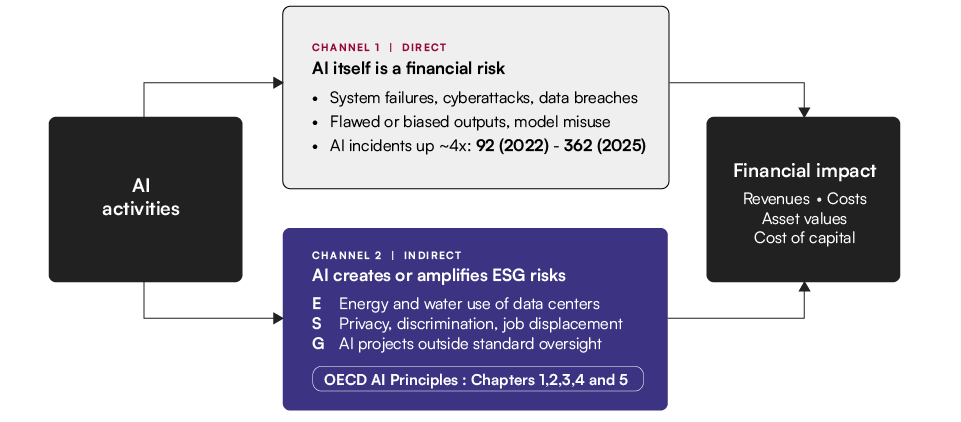
AI can affect companies through two different channels:
The first channel is direct:
AI itself is a source of financial risk. It extends familiar IT risks, such as system failures, cyberattacks and data breaches, and adds new ones, such as flawed or biased outputs and misuse of AI models. These failures show up as AI incidents, which are rising quickly as adoption spreads: the AI Incident Database recorded 362 incidents in 2025, up from 92 in 2022, a near four-fold increase.ii Each incident can lead to fines, litigation, remediation costs, lost customers or reputational damage, all of which hit the bottom line.
The second channel is indirect:
AI creates new or expands existing ESG risks, which are in turn financially material. Data centers consume large amounts of energy and water, increasing environmental exposure. AI systems can infringe privacy, discriminate against individuals or displace jobs, raising social and human rights concerns. And fast-moving AI projects often escape the governance and oversight standards applied to a company’s other activities. Just like traditional ESG risks, these can translate into regulatory penalties, legal claims and a higher cost of capital.
The OECD AI Principles mainly address the second channel, giving investors a structured and focused way to assess them.
Figure 1: Two Channels of AI Financial Materiality
The OECD AI Principles Framework in Brief
First launched in 2019, the framework was updated in 2024 to reflect evolving market expectations and recent developments in the industry. It is organized into five chapters addressed to AI actors, including companies, and sets out five recommendations addressed primarily to governments and policymakers.
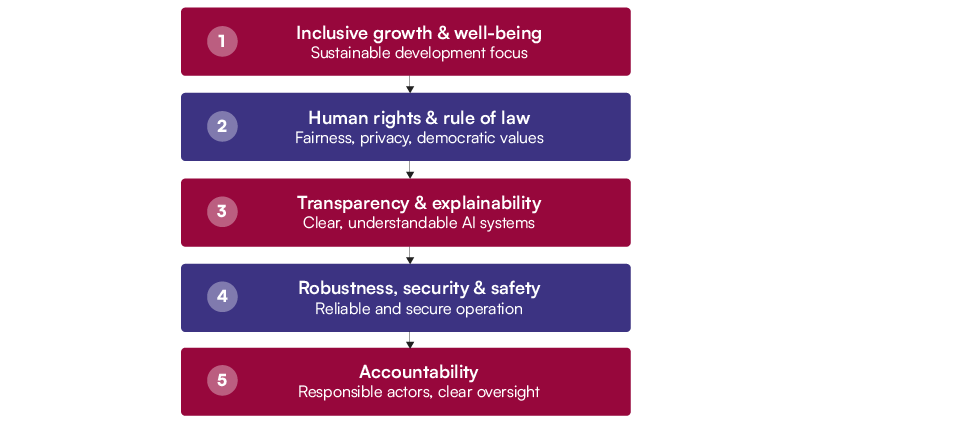
The five chapters correspond to the framework’s five values-based principles: inclusive growth, sustainable development and well-being; respect for the rule of law, human rights and democratic values, including fairness and privacy; transparency and explainability; robustness, security and safety; and accountability. Together, they set expectations across the full AI lifecycle, from design and data collection through to deployment and ongoing monitoring.iii
Figure 2: The OECD AI Principles
The principles were the first intergovernmental standard on AI and now have 47 adherents, including OECD members, the European Union and several non-member economies; they were subsequently reflected in the G20 AI Principles. The 2024 revision responded to the rapid rise of general-purpose and generative AI, sharpening the treatment of safety, privacy, intellectual property and information integrity.
Like other OECD frameworks, such as the OECD Guidelines for Multinational Enterprises, it is intended to apply to companies worldwide, and it offers a clear, accessible basis for investors to make informed decisions and screen out companies that are not aligned with the principles.
The Special Case of AI: Why a Dedicated OECD Framework?
As the two channels above show, AI generates challenges that traditional ESG frameworks are not well equipped to evaluate. The OECD introduced a dedicated AI framework because AI’s impact brings:
- Amplified Environmental Footprint: The rapid scale-up of AI workloads creates outsized resource demands, from extreme energy consumption to intensive water use for data center cooling.
- Unprecedented Systemic & Technical Risks: Unlike standard business activities, AI introduces dynamic risks around algorithmic accountability, data privacy, social manipulation, and autonomous decision-making.
Because these risks are both highly material and structurally distinct from traditional corporate activities, standard ESG screening is insufficient—demanding a tailored, tech-specific governance standard.
Inrate’s OECD AI Principles Screening
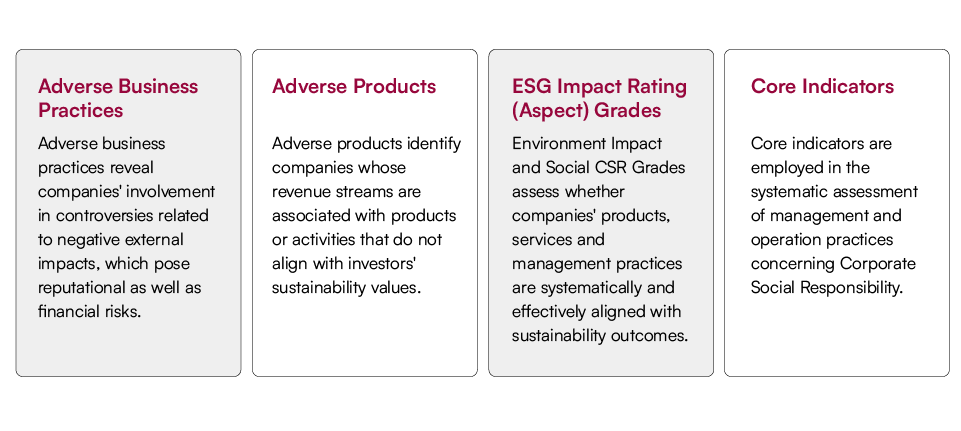
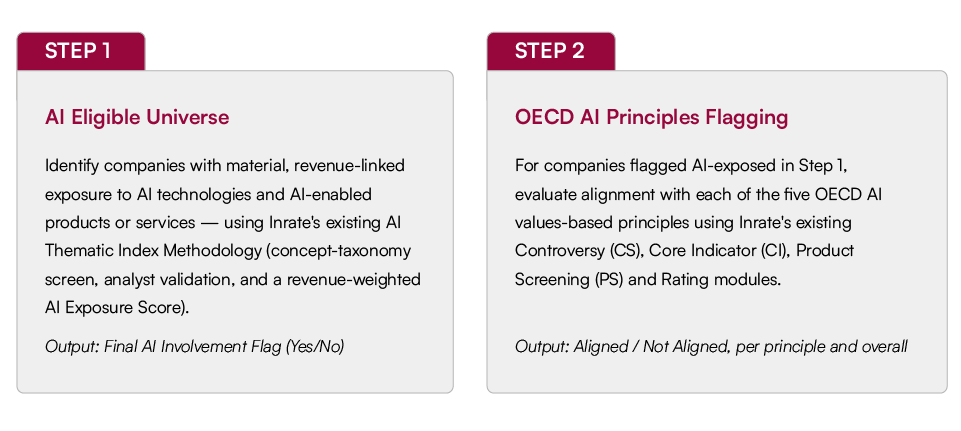
Leveraging Inrate’s in-house research capabilities, which cover a large set of indicators, controversies, ratings, and scores, Inrate has developed an assessment tool to screen companies on whether they are aligned with the OECD AI framework (Figure 3). The tool extends other Inrate screening tools such as the OECD, UNGP, and UNGC screens. These tools allow investors to screen out companies exposed to material risks flagged by these frameworks.
Figure 3: Inrate’s OECD AI Framework
To identify investments that conflict with established values and principles, the screening framework evaluates a company’s alignment with the OECD AI Principles (2019, updated May 2024) across five value-based dimensions: inclusive growth and well-being, human rights and fairness, transparency and explainability, robustness and safety, and accountability.
The following section provides a detailed explanation of the elements included in this assessment.
Insights from Screening a Global Universe Using OECD AI Principles
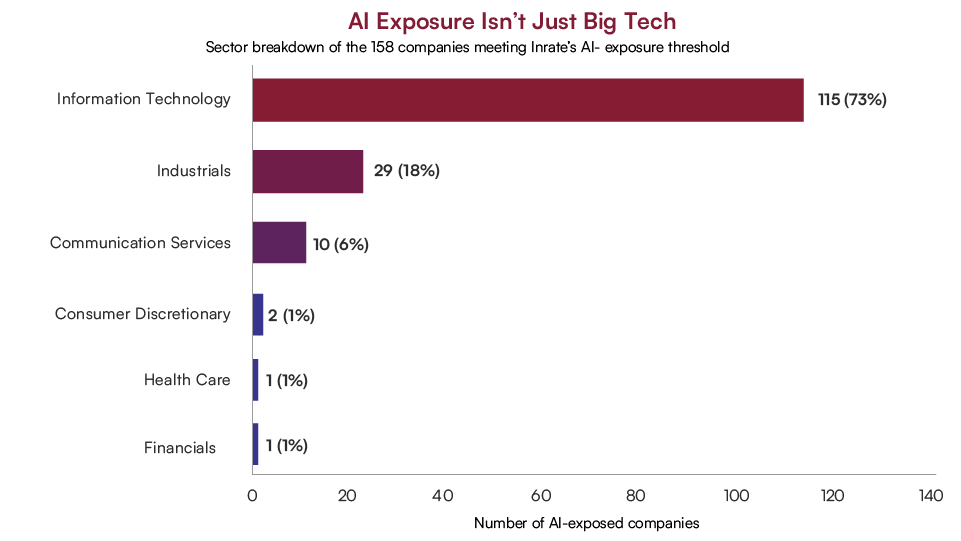
Examining a global universe of about 10,000 companies, we assess them using Inrate’s OECD AI framework. The first pass measures each company’s AI exposure. Every business activity is scored from 0 (no AI exposure) to 1 (core AI), and these scores are averaged across the company’s activity mix, weighted by revenue. The resulting score ranges from 0, for companies with no AI exposure in any of their activities, to 1, for companies whose activities are all core AI. Applying a threshold of 0.4 leaves 158 companies. Although most of these are in the IT sector (115 companies), a substantial number belongs to neighboring sectors such as Industrials (29), Communication Services (10), and Consumer Discretionary (2), with the remaining 2 in other sectors, as shown in Figure 4.
Figure 4: Sector Breakdown of AI-Exposed Companies
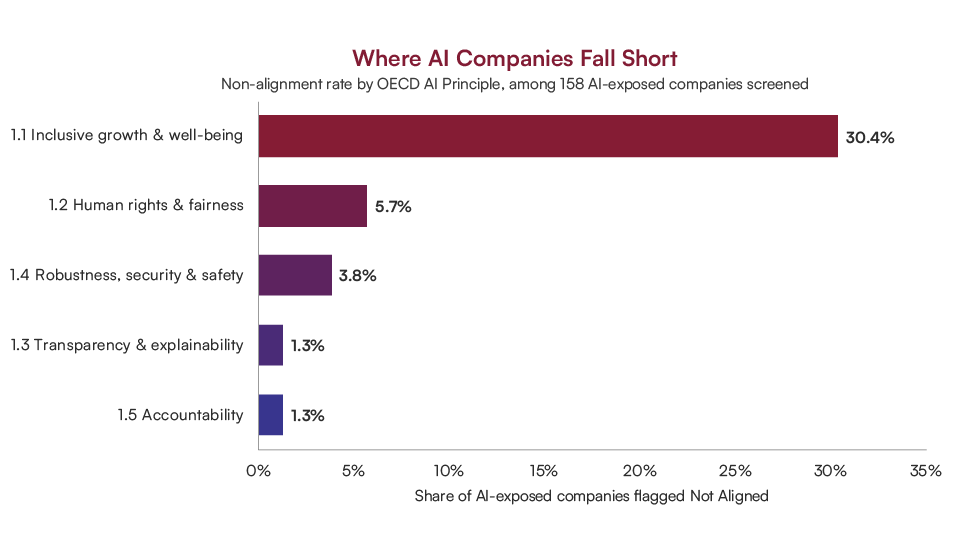
When screening companies that are exposed to AI activities against the OECD AI principles, we find varying levels of alignment across chapters (Figure 5). The highest non-alignment ratio pertains to Chapter 1 on inclusive growth and well-being, at 30.4%. This is mostly driven by the absence of GHG emission reduction programs and green procurement programs. These companies also have low Environmental CSR Grades. Chapter 2 on human rights and fairness comes next, with a non-alignment rate of 5.7%, followed by Chapter 4 on robustness, security, and safety at 3.8%. Chapter 3 on transparency and explainability and Chapter 5 on accountability appear to be the strongest, each with a non-alignment rate of 1.3%.
Most importantly, we have 103 out of 158 that comply with all five chapters, i.e., 65.2%, while 55 companies, or about 34.8%, fail in at least one of the 5 chapters.
Figure 5: Non-Alignment Rate by OECD AI Principle