


Until recently, many Gulf Cooperation Council (GCC) countries had enjoyed political stability and steady economic growth despite fluctuations in the oil and gas prices. While their economies remain heavily dependent on these commodities, several states have begun to diversify by investing in sectors such as transport, services, infrastructure, and even artificial intelligence. Progress has also been made on environmental and social fronts, with some governments committing to global initiatives, including the Paris Agreement.
However, the current regional conflict may abruptly disrupt this trajectory. GCC economies now face heightened security risks and growing economic uncertainty. Investors and market participants are closely monitoring developments and adjusting their expectations in real time.
Our analysis examines GCC countries’ ESG performance over previous years and identifies key indicators that are likely to impact sovereign ESG ratings in the weeks and months ahead.
Inrate’s Country ESG Ratings
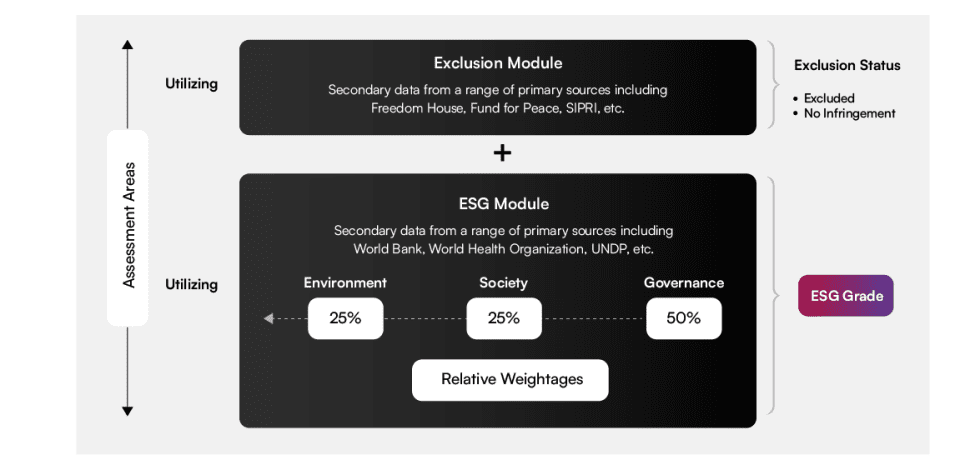
Inrate’s rating methodology evaluates a country’s impact and contribution to sustainable development. It focuses on the sustainable development of countries, emphasizing areas where countries exert direct influence, such as legislation and regulation, or where they hold significant roles. These primarily encompass aspects such as institutional capacities, political programs, regulatory frameworks, and law enforcement.
The ESG module evaluates a country’s efforts toward sustainable development, focusing on environmental, social, and governance factors. It provides a snapshot of actions crucial for sustainable development.
Assessments within the ESG module yield an overall ESG score and grade, as well as individual scores and grades for E, S and G aspects for each country, subnational and supranational.
A second module called exclusion module includes topics related to a country’s institutional framework, encompassing indicators for core responsibilities and minimum requirements.
Exhibit 1: Inrate’s Country Rating Assessment Process
Good Social Performance, Moderate Environmental Results, and Weak Governance
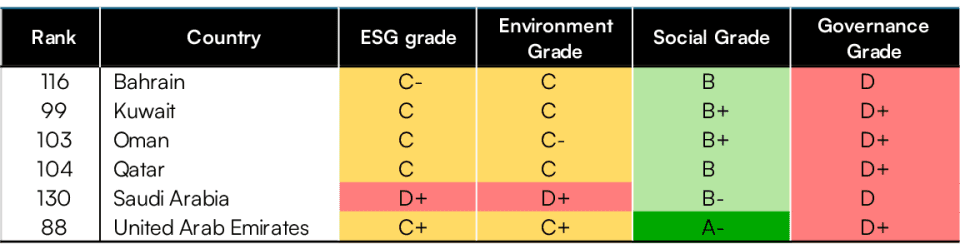
Exhibit 2 reports the current ESG performance across six Gulf Cooperation Council countries, highlighting notable differences in environmental, social, and governance dimensions.
Overall, all ESG grades belong to the third tier and range from C+ for the United Arab Emirates—the strongest performer—to D+ for Saudi Arabia, which ranks lowest among the group. The relative underperformance is primarily due to governance factors, with environmental factors also contributing to a lesser extent.
In fact, social grades show stronger relative performance, led by the UAE with an A-, followed by Kuwait and Oman at B+, and Bahrain and Qatar at B. This outperformance is driven by excellent indicators in health, education, security, and employment rates. Equality and business climate remain areas for progress. The recent crisis will have immediate impact on business climate, but less likely to impact long-term pillars such as health and education, unless we see a dramatic worsening of the crisis. Some impact may also be observed in the labour market if safety conditions were to further deteriorate.
Environmental scores are generally modest, with most countries clustering around C to C-, while Saudi Arabia stands out with a D+. The modest performance is due to a high pollution level, high energy consumption per capita and the fossil fuel energy and the lack of use of renewable energy. GHG emission per capita remain high. On the bright side, important progress has been made on biodiversity resources and water sanitation.
Exhibit 2 Country ESG Ratings for Gulf Cooperation Council (GCC) Countries
Source Inrate
However, governance represents the Achilles’ heel, with grades consistently weak across the region; all six countries receive D or D+, underscoring systemic governance challenges. On a positive note, within this category, the Political Stability and Global Peace indices remain high. However, these indicators are likely to be affected by the current crisis in the Middle East, potentially leading to a deterioration in the governance dimension.
Overall, the table reflects a pattern of moderate environmental performance, relatively strong social outcomes, and persistently low governance scores across the GCC. Depending on the duration of the conflict, indicators related to political stability, peace, innovation, and energy transition efforts could be particularly affected.
Improved but Fragile Political Stability
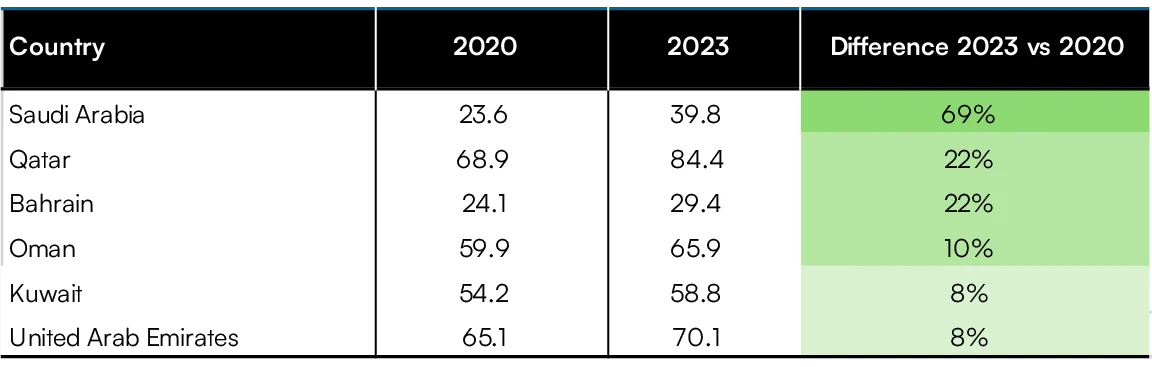
Exhibit 3 reports on the Political Stability Index for GCC, where higher values equate to higher stability. In absolute terms Qatar is the most stable country in 2023 with a score equal to 84.4, followed by the UAE, 70.1. Bahrain is the least stable country in this group, with a political stability index of 29.4. In terms of progression, Saudi Arabia tops the ranking, with an astonishing progression of 69% since 2020, while UAE had the lowest progression, 8%.
Qatar’s high political stability score is underpinned by its high GDP per capita and significant investment in social and infrastructure development. However, recent strikes in the country, along with its delicate geopolitical positioning, could weigh on its future political stability score.
Saudi Arabia’s improved political stability score is closely correlated with its higher global peace score, as the government Vision 2030 reforms and diplomatic outreach have strengthened its positioning in regional cooperation and its ability to govern efficiently.
Exhibit 3 Political Stability Index over Time
Source World Bank, Inrate
While GCC countries score relatively well on political stability, continued progress is needed to address longstanding challenges such as labour conditions, migrant worker protections, and equality.
Significant Progress in Peace Score in Recent Years
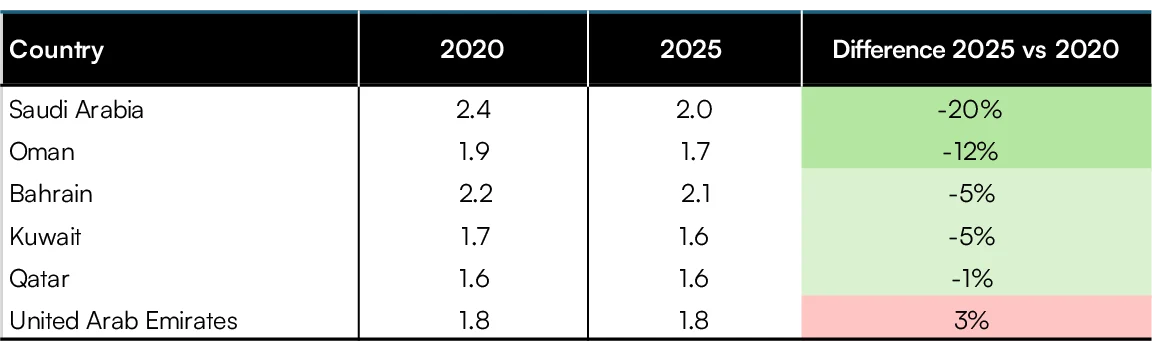
Exhibit 4 reports the Global Peace Index Score for GCC where lower values mean better peace conditions. All the countries have registered an improvement in peace conditions. The only exception is that of the UAE, which registered a slight decrease. The most noticeable progress is that of Saudi Arabia, with an improvement in the Global Peace Index Score of 20%, followed by Oman, 12%.
This progress is especially notable because the Global Peace Index has found that peacefulness continues to decline around the world and that the Middle East and North African region is the world’s least peaceful region.
Nonetheless, the GCC countries have seen overall improvements in their peace scores in 2025. Qatar is the most peaceful country in its region, although political uncertainty increased after legislative elections got abolished. Saudi Arabia, as noted below, recorded the largest improvement in peacefulness in the region, primarily driven by a decrease in deaths from internal conflict, as well as by governmental reforms and diplomatic outreach strengthening its position in regional cooperation and mediation.
Exhibit 4 Global Peace Index Score over Time
Source Institute for Economics & Peace, Inrate
Global Innovation Index Ranking: Strong Upward Momentum in the GCC
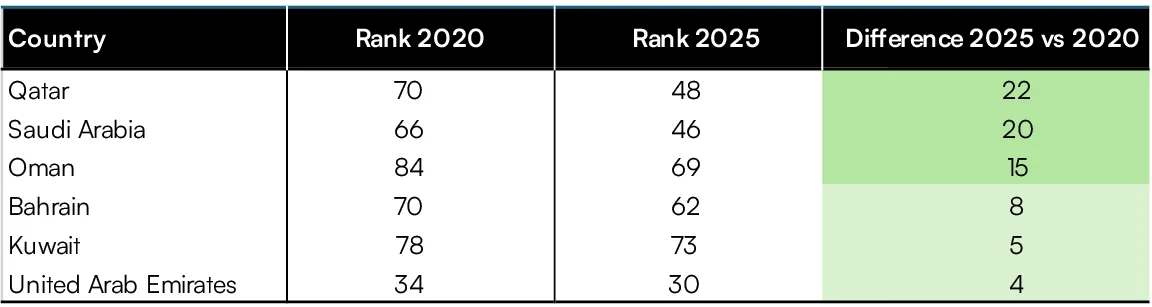
Exhibit 5 shows that, between 2020 and 2025, all the countries improved their Global Innovation world rankings, with some such as UAE reaching a world rank of 30. Overall, the countries are among the year’s most significant upward movers, propelled by advances in infrastructure, expanding research capacity, and stronger connections between industry and universities. Qatar and Saudi Arabia gained 22 and 20 marks in the global ranking, respectively.
Exhibit 5 Global Innovation Index Ranking
Sources WIPO, Inrate
Mixed Performance in Energy Transition
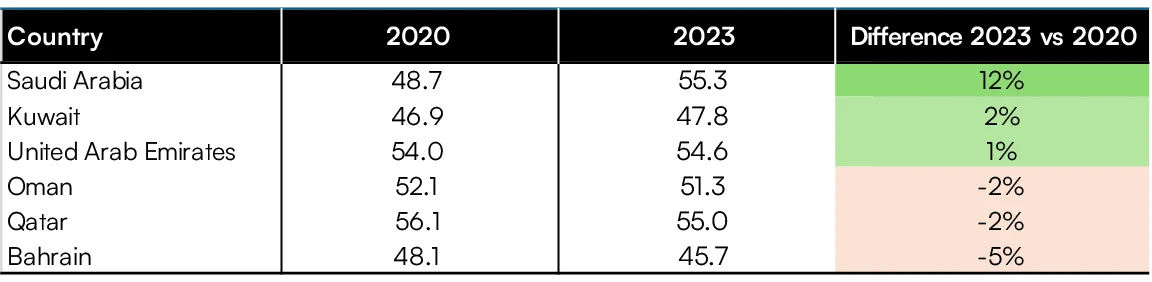
The Energy Transition Index had mixed results, with some countries taking initiatives to gradually move away from fossil energy, while others still maintain their reliance on this abundantly available resource. For example, the United Arab Emirates’ score was led by targeted subsidy reforms, rising clean energy shares, falling energy intensity and continued expansion of a key nuclear power plant, which is now supplying nearly 25% of the country’s electricity.
However, fossil fuel dependency and grid inflexibility remain major barriers to a faster energy transition in these countries, and clean energy still accounts for a limited share of total supply. Heightened geopolitical tensions in the region could further constrain governments’ ability and willingness to invest in innovation and infrastructure for cleaner energy production.
Exhibit 6 report on the Energy Transition Index for GCC where higher scores reflect a state’s willingness to achieve more sustainable energy systems.
Exhibit 6 Energy Transition Index
Source World Economic Forum, Inrate
Key Takeaways for Investors and Corporations
In addition to ongoing oil price volatility and persistent regional tensions, the GCC’s economic resilience may be further tested by a more immediate and direct security threat. Our analysis suggests that the current conflict is likely to influence country-level ESG impact ratings in both the short and longer term.The most immediate effects are expected to be felt in the business environment, as well as in political stability and peace-related indicators. At the same time, the financial burden of managing the crisis could shift policy priorities in the near term, potentially slowing progress on climate transition efforts and economic diversification.
If the situation persists, broader social implications may also emerge, including a potential deterioration in labor conditions and workplace safety.
Ultimately, the key uncertainty remains the duration and intensity of the conflict. The longer it endures, the more entrenched its effects are likely to become and the more prolonged the recovery for GCC economies.
References
- World Intellectual Property Organization (WIPO).Global Innovation Index 2025. [https://www.wipo.int/web-publications/global-innovation-index-2025/assets/89507/global-innovation-index-2025-en.pdf ]
- World Economic Forum.Fostering Effective Energy Transition 2023. [https://www.weforum.org/reports/fostering-effective-energy-transition-2023/ ]
- The World Bank.Political Stability and Absence of Violence/Terrorism: Percentile Rank. [https://data.worldbank.org/indicator/PSAVT ]
- Institute for Economics & Peace.Global Peace Index. [https://www.visionofhumanity.org/maps/global-peace-index/] [https://www.visionofhumanity.org/wp-content/uploads/2025/06/Global-Peace-Index-2025-web.pdf]
- DW,.What to know about Qatar, the Middle East’s quiet power. https://www.dw.com/en/what-to-know-about-qatar-the-middle-easts-quiet-power/a-739i